Pages

background

Friday, January 31, 2014

GRANDPA GREEN by Lane Smith

This stunningly illustrated picture storybook takes us on an excursion through a garden with spectacular shaped topiary trees.  A young boy is walking through this garden, helping out his forgetful great-grandfather.  While he walks through the garden, the story of his grandpa's life is told through the shaped topiary trees.

The reader will instantly fall in love with the young boy and his Grandpa Green, as his memories are kept in the garden.  The reader learns throughout the story that Grandpa Green was not always a gardener, but a farm boy, had chicken pox, and a soldier.  Lane Smith, the author and illustrator, takes us on a voyage to explore aging and family memories.  The theme of this book is wonderful for parents and children as it speaks about the importance of keeping our family memories alive.
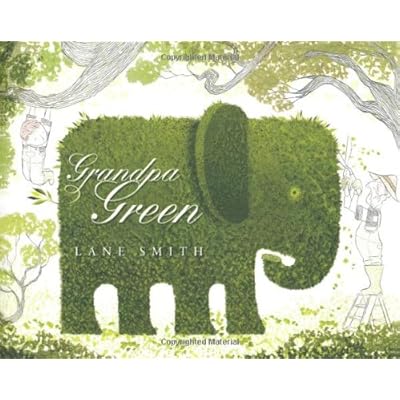
Lane Smith uses brush and waterproof drawing ink to depict the characters in this story.  The garden's foliage, which is a very large part of the story, was created with watercolor, oil paint, and digital paint.  The foliage is very realistic and almost seems to come off the pages.


Honors and Awards for Grandpa Green

America Library Association Notable Children's Books
Caldecott Award Honor Book 2012
GA Picture Story Book Award
New York Times Best Illustrated Book

Book Reviews


"Sketched with a finely lined fairy-tale wispiness and dominated by verdant green, the illustrations are not just creative but poignant especially after it is revealed that the boy is the great-great-grandson of the old man whose life is being described, and whose failing memories are contained in this garden."
         -Booklist 2010


"Smith works in an impressionistic range of emerald, moss, and seaweed hues, memorializing Grandpa Green's life events in meticulously pruned shrubs."
         -Publisher’s Weekly Review

"A clever premise, brilliant pacing, and whimsical illustrations offer a distinctive look at the life and artistic vision of one great-grandfather."
         -School Library Journal

"Though this book has lots of adult appeal, it will also be a wonderful bridge to exploring family history with the very young."
            -Kirkus Reviews

Connections

Classroom teachers can utilize this book in their writing lessons and have the students collect information about a special family member to write a memoir.  

Classroom teachers and librarians can use this book to teach connections between the illustrations and the text.  Have the students make connections to their life, for example, ask "Not everyone makes topiaries to keep memories, what are some ways that your family keeps your memories?"  


Smith, Lane. 2011. Granpa Green. Illustrated by Lane Smith. New York: Roaring Book Press.
 ISBN 9781596436077

Saturday, January 25, 2014

ELOISE by Kay Thompson

Kay Thompson created the six year old character of Eloise during a night club act where she was performing.  She teamed up with the illustrator, Hilary Knight, and together they created the fabulous children's book, Eloise.  In 2003, a movie was created based on the Eloise character.

Eloise has remained on the Top 100 Picture Books list for School Library Journal over the years.  In 2012, it moved down to #76 on the list.  

The book is about a very mischievous, prankster girl, Eloise, with absent parents being raised by a nanny and other servants at the Plaza hotel.  While reading the book, you can 'hear' the six year old talking as you go through each page.  It is written just as a six year old would talk. While the absence of punctuation bothered me a bit, it added to the fun of the book and made it appear as though the six-year old was actually writing this story down.  

The plot, while unbelievable and exaggerated, is humorous and can be enjoyed by children and adults.  The setting, the Plaza Hotel, may be alien to many children, however it creates a fantasy world for children that have never experienced a fancy setting.  Children that do not often see their parents can make a connection to Eloise, as her parents are absent throughout the book.  

The illustrations are essential to the story and add small, yet important, details that the words alone do not allow the reader to perceive.  The character, Eloise, is shown as a messy-haired, six-year old girl who has a vivid imagination.  The illustrations are not-modern, but keep with the tone of the book, being mostly black and white, with only red being shown in the colors.  Even Eloise's underpants are pink, which children will find delightfully hilarious. Eloise has a red bow, the Plaza's carpet runners are red, and the servants bow ties are often red.  The illustrator, Hillary Knight, uses her illustrations to demonstrate Eloise's many imaginations and pretend play.  When Eloise is pretending, the illustrations are outlined with dotted lines and not colored in, depicting a distinct difference in what is real and what is in Eloise's imagination. In the illustration of Eloise's room, Knight uses great detail to show how messy Eloise truly is, including a calendar on the wall depicting which days the room was messy or clean.  Every day on the calendar is marked messy.  

"While the kids are giggling over her antics and the hilarious illustrations, parents will like the sly parody of the adult world."
- Common Sense Media Review


Thompson, Kay. 1955. Eloise. Illustrated by Hillary Knight. New York: Simon & Schuster Books for Young Readers. ISBN 067122350X

Author information retrieved from http://www.eloisewebsite.com/kay_thompson.ht 


Tuesday, January 21, 2014

WHAT'S THE MATTER, HABIBI?

Written and Illustrated by Betsy Lewin


Habibi, the camel, is a delightful character who one day decides he wants to have something a little fancy to brighten his day.  One day, Habibi refuses to carry the children around and his owner cannot figure out what is wrong with Habibi.  The owner then spends the day running through the city searching for his camel with the 'sense of style'.

The plot is very humorous, and the story begins on the title page with a very interested Habibi, along with his owner, passing by the fez stand at the Arab bazaar.  The setting of the story is depicted in the beautiful illustrations and in the vocabulary words throughout the story.   The author, Betsy Lewin, uses onomatopoeia throughout the story, which adds a unique quality to the story.  Lewin uses black outline with watercolors for the beautiful illustrations in the children's book.  The illustrations are very lively and add something magical to the story.  Black squiggly lines outline the people showing action and sometimes chaos.     "‘Lewin's expressive, playful line-and-watercolor illustrations bring to life this funny tale" (Taniguchi 2010).  


This whimsical book would be loved by school children for story time in the classroom or library.  Teachers and librarians could utilize this picture book to teach onomatopoeia and use of strong vocabulary words.  

Lewin, Betty. 1997. What's the Matter, Habibi? New York. Clarion Books. ISBN 039585816X

Taniguchi, Marilyn. Review of What's the Matter, Habibi? School Library Journal. 2010.


Thursday, January 16, 2014

Welcome

I have created this blog for my LS 5603 Children and Young Adult Literature Course.  I will post weekly reviews over children's and young adult literature.  I hope you enjoy the reviews and can find something new to read or to share with your students.