Pages

background

Monday, February 24, 2014

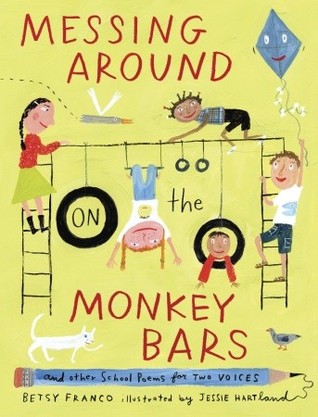
MESSING AROUND ON THE MONKEY BARS by Betsy Franco

This collection of poems by Betsy Franco, illustrated by Jessie Hartland, is sure to incorporate fun into any classroom or library.  Messing Around on the Monkey Bars and other School Poems for Two Voices is a collection of nineteen poems meant to be read aloud in pairs, or two groups.  The words in the poems are written in different unbold, bold, and more bold to show reader #1 and reader #2 and what should be read together.  What a fun way to invite children to read!

The children in the poems are on the playground skipping rope, in the library being hushed by the librarian, and worrying about a report that is due... tomorrow!?  The collection of poems all have a school theme that young children will be able to relate to.  Some of the poems are written to be performed with two voices, with overlapping lines.  Many of the poems can also be read to music, or as a song.  In the back of the book, the author includes "Adventurous Ways to Read the Poems" (Franco 2009, 46).

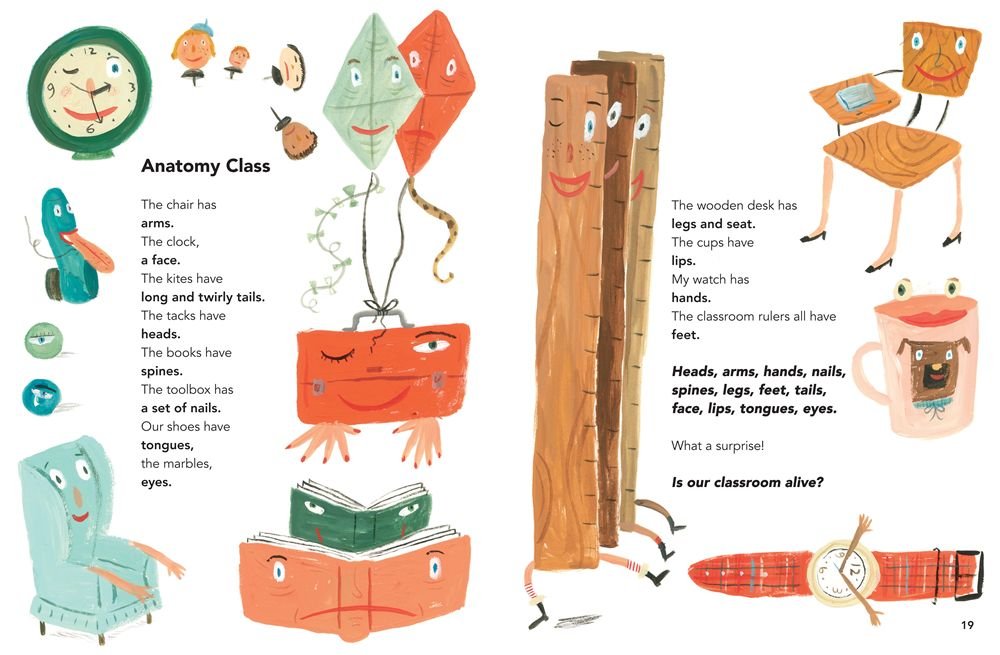
The illustrations, done in gouache, by Jessie Hartland provide humor and liveliness to the poems, showing the children in action.  The illustrations are done in cartoon like details, which will appeal to children.  On the poem titled "Lunch Money", the children are running to get in line, and one boy has his pockets turned out with a look of horror on his face as he realizes he has no lunch money.  "Anatomy Class" is a poem describing the objects in the room, personifying the objects by giving them faces and legs and arms.  The illustrations on this page make the objects in the poem come to life.

Franco, Betsy. Messing Around on the Monkey Bars and other School Poems for Two Voices. 
Illustrated by Jessie Hartland. Massachusetts: Candlewick Press. 2009.  ISBN  9780763631741

Reviews for Messing Around on the Monkey Bars

"A cheeky romp through elementary school children's academic and social lives." -- Kirkus Reviews
"Teachers and librarians looking for readers' theater materials will be delighted with this collection.... this book will please the class poets, performers, and clowns alike."              -- School Library Journal 
"Franco's jaunty rhythms are well suited to reading aloud and she has designed these poems well for the back-and-forh of two voices or two groups." -- Poetry for Children

Awards for Messing Around on the Monkey Bars

Chicago Public Library Best of the Best Books

Other poem collections by Betsy Franco

Falling Hard: 100 Love Poems by Teens, editor Jen Yoon
Pond Circle (McElderry Books 2009)
Math Poetry: Linking Language and Math in a Fresh Way (Good Year Books 2006)


Teachers and School librarians may find this teacher's guide interesting and useful.


Sunday, February 23, 2014

THE ONE AND ONLY IVAN by Katherine Applegate


The One and Only Ivan, written by Katherine Applegate, is a beautiful story of the treatment of animals, good and bad.  It is written from Ivan's, the ape, point of view in free verse chapters. Ivan is a silverback gorilla who was captured as a baby gorilla, and he has grown up at the Exit 8 Mall in his domain where his drawings sell in the gift shop.  After over 9,000 days in his domain, Ivan has grown accustomed to humans staring at him.  Ivan has friends that live at the shopping mall with him:  Stella the elephant and Bob the stray dog, who sleeps with Ivan every night.  As a silverback, Ivan knows that he is meant to protect his family, but he has no one to protect.  Until the baby elephant, Ruby, comes to live with them.  Ruby encourages Ivan to remember his life in the jungle before his cage. Ivan begins painting and drawing for Ruby and realizes that he is meant to protect Ruby and must find her a better life.  


Applegate, Katherine. The One and Only Ivan. Illustrated by Patricia Castelao.  
New York: HarperCollins Children's Books, 2012  ISBN 9780061992254

This book, written in first person narrative, is a very emotional read.  The reader will be happy, sad, and angry throughout the book.  The book has a theme of friendship and teaches the reader that with true friends, you can bear anything.  Children will see human kindness and human cruelty through the tales of the gorilla, Ivan.  Children will love Ivan and the other animals as the characters come to life in this book and the descriptions from Ivan. They will cheer the animals on as they fight for a better way of life. 

The author based Ivan, and a few other characters, on a true story of a gorilla in captivity. The real gorilla was also named Ivan and lives at Zoo Atlanta.  Katherine Applegate includes an author's note at the back of the book with a story about the real Ivan.  There is also a website for The One and Only Ivan where you can read about the real Ivan here.


The illustrations throughout the book, by Patricia Castelao, are a pleasant addition to the book, giving children a picture of what a silverback gorilla looks like.  The illustrations show us the different facial expressions and emotions of the animal characters throughout the book.  With the exception of the cover, the illustrations are in black and white.  The cover art is also done by Patricia Castelao and shows the friendship of Ivan and Ruby.

Awards for The One and Only Ivan

School Library Journal Best of Children's Books 2012

Texas Bluebonnet Award 2013-14 Master List

Chicago Public Library Best of the Best 2012

2013 Newberry Medal

Reviews for The One and Only Ivan

"The characters will capture readers' hearts and never let go.  A must-have."  -- School Library Journal
"Beautifully written, intelligent, and brave book... Quite simply, this book is a life-changer" -- Patricia MacLachlan, Newberry Medalist, Sarah Plain and Tall
"The One and Only Ivan will break your heart--and then against all odds, mend it again." -- Gary D. Schmidt, Newberry Honor Author of The Wednesday Wars 

Other Books by Katherine Applegate

The Buffalo Storm (Clarion Books, 2007)

Roscoe Riley Rules, chapter book series (HarperCollins, 2008)

Home of the Brave (Square Fish, 2008)


Monday, February 17, 2014

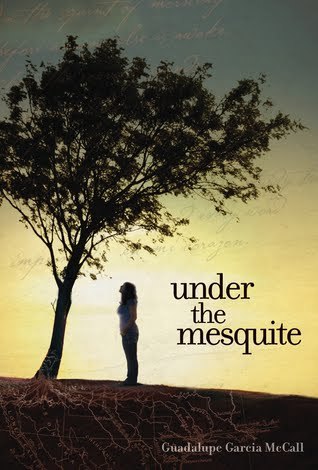
UNDER THE MESQUITE by Guadalupe Garcia McCall

Under the Mesquite, by Guadalupe Garcia McCall, is a beautifully written free verse novel about the struggles of a teenage Mexican-American girl as she comes of age.  The reader immediately falls in love with Lupita, the main character, who is a budding writer and actor.  Through the verse in this novel, the reader sees the struggles that Lupita goes through as she moves to a new home, los Estados Unidos.  McCall gives flashbacks in Lupita's life as a young girl in Mexico to give more understanding of her cultural roots.  As Lupita enters high school, she learns that her mother has cancer, and Lupita must take on more responsibility in the home.  We follow her through these struggles as the novel emotionally describes how Lupita overcomes and realizes the importance of family.  She escapes the chaos at home by writing down her emotions in the shade of a mesquite tree growing in the middle of her mother's rose garden.

The free verse novel is full of figurative language that provides emotions and meaning to much of Lupita's life.  "His hands were rough and scratchy / against my skin, and the bits of sawdust / clinging to his work clothes / were tiny mosquitoes biting into my arms" (McCall 2011, 32).  With well placed Spanish, including a glossary in the back of the book, McCall demonstrates how Lupita is able to still hold on to her heritage while also becoming an American teenager.

Garcia McCall, Guadalupe.  Under the Mesquite.  New York: Lee & Low Books, Inc., 2011.  ISBN:  9781600604294


Book Reviews

"With poignant imagery and well placed Spanish, the author effectively captures the complex lives of teenagers in many Latino and/or immigrant families." -- Kirkus Reviews
"The simplicity of the story line belies the deep richness of McCall's writing." -- School Library Journal
"The close knit family relationships... are vividly portrayed, as is the healing comfort Lupita finds in words." -- Booklist

Awards for Under the Mesquite

Winner of the 2012 Pura Belpre Award
2012 William C. Morris Debut Award Finalist
Top 10 Can't Miss Fall Books for Teens (Kirkus Reviews)

Other Books by Guadalupe Garcia McCall

Summer of the Mariposas

Read about the author here.

Connections

If you enjoyed Under the Mesquite, try these books:

Inside Out & Back Again by Thanhha Lai 

Second Chance Summer by Morgan Matson


Tuesday, February 11, 2014

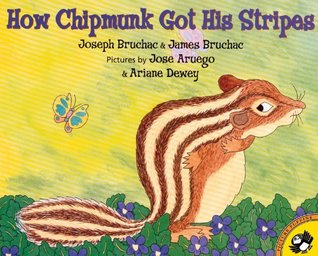
HOW CHIPMUNK GOT HIS STRIPES by Joseph Bruchac & James Bruchac

How Chipmunk Got His Stripes, retold by Joseph Bruchac and James Bruchac, is a Native American Pour quoi tale.  Pour quoi is French for "why" or "how come". The main characters in this delightful folktale are Big Bear and Brown Squirrel, who both have human traits, common to pour quoi tales.  Big Bear walks along bragging and bragging that he can do anything.  Brown Squirrel does not believe Big Bear, so he dares Big Bear to command the sun not to come up the next morning.  Of course Big Bear, the braggart that he is, declares that he will be able to keep the sun from rising.  To Big Bear's dismay, he is unable to keep the sun from rising.  Brown Squirrel cannot resist teasing, even though his grandmother taught him to never, ever tease others.  Every bad deed has a consequence, and Brown Squirrel must wear his consequence on his back after Big Bear's claws come in contact with him.  The reader learns a lesson of pride and anger. 

Throughout this charming tale, the authors' have used effective dialogue that will encourage audience partipation during a read aloud.  Big Bear brags "I am Bear, I am the biggest of all the animals. Yes, I am!" (Bruchac & Bruchac). This verse is repeated throughout the story, allowing young children to read along and predict the upcoming words.  There are wonderful opportunities for the story teller to add enjoyable sound effects.  "The sun is going to rise, oooooh! The sun is going to rise, oooooh!" and "The sun will not come up, hummmph! The sun will not come up, hummmph!" (Bruchac & Bruchac).

The book is illustrated by Jose Aruego and Ariane Dewey using pen-and-ink and watercolor.  The illustrators create a vivid image of the forest where the animals live.  Big Bear and Brown Squirrel are very well illustrated, showing life-like fur on both characters.  My favorite illustration is that of the forest animals joining Big Bear and Brown Squirrel as they wait through the night to see if the sun will come up.  The expressions on the animals' faces are cartoon like, adding a bit of humor to the story.


Bruchac, Joseph and James Bruchac. How Chipmunk Got His Stipes. Illustrated by Jose Aruego and Ariane Dewey. New York: Dial Books for Young Readers, 2001.  ISBN 0803724047


"As a child, I heard this story from my father namy times, but it took on a new life for me after I began my own storytelling career and saw how young audiences reacted to it." -- James Bruchac

Reviews for How Chipmunk Got His Stripes

"Aruego and Dewey's vibrantly hued trademark watercolors add significantly to the humor" -- School Library Journal
"The dialogue is effective and invites audience participation--especially the repeated phrases with sound effects." -- Publisher's Weekly 
Find out more about Joseph Bruchac and James Bruchac.


Saturday, February 8, 2014

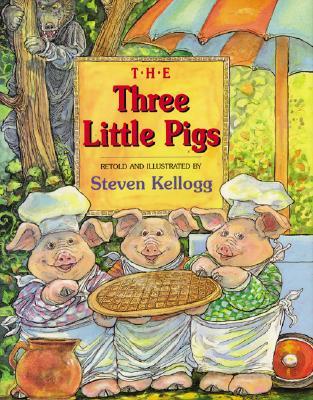
THE THREE LITTLE PIGS retold and illustrated by Steven Kellogg

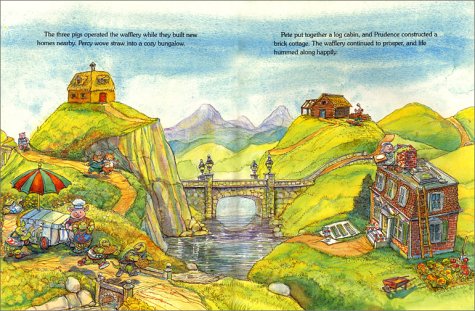
This familiar story of The Three Little Pigs is retold by Steven Kellogg.  Kellogg begins the story with a background story of the three pigs and their mother.  Percy, Pete, and Prudence, along with their mother, Serafina Sow, own a waffle business.  Children will delight in the story, as the pigs are given names and begin as children at school, a variant from the traditional Three Little Pigs story. The mom retires to Gulf Pasta and turns over the business to her three children.  This is when we meet the wolf, Tempesto, who does not want a waffle, but instead wants to eat the three pigs. The character of the mother pig, Serafina, is greatly expanded in this story and is a source of solving the pigs' problem.  The story ending is very light and will be intriguing to children. 
The appealing illustrations, also by Steven Kellogg, add wit and humor to the story.  The wolf, Tempesto, appears in a leather jacket with a symbol of cross bones on his jacket, along with biker boots.  Included in the illustrations are text on signs and paper airplanes adding humor to the story line.  Readers will have fun looking at the art on the pigs' walls and the slogans on the wolf's t-shirts throughout the story.  The illustrations depicting the waffle business include the flavors of the waffles, which will be a delight to read for children and adults.  The illustrations are done with watercolors and acrylic in full color.  


Kellogg, Steven.  1997. The Three Little Pigs. New York: 
Harper Collins Publishers. ISBN: 0688087329

Connections for the classroom:

This rendition of The Three Little Pigs will be a wonderful addition to your fairy tale unit to show students the different variations of the story.  
Teacher's can pair this story with Jon Scieska's The True Story of the Three Little Pigs (Viking 1989) to show the wolf's side of the story.  

More Books by Steven Kellogg

Chicken Little, ISBN 978-0688070458
Is Your Mama a Lama?, ISBN 978-0590259385
Johnny Appleseed, ISBN 978-0688064174
A, My Name is Alice, ISBN 978-0140546682

Reviews

"Just as the pig family in this story soups up their old waffle iron with four wheels and various tanks, pieces, and hoses, so Kellogg takes a favorite folk tale and adds his own invention touches of character, plot twists, and humor." -- Booklist

"Kellogg's usual busy, highly defined illustrations complement the humorous, clever text. -- School Library Journal

"Buoyant pictures and a pun-riddled text add gusto to Kellogg's light hearted humor." -- Publisher's Weekly


Friday, February 7, 2014

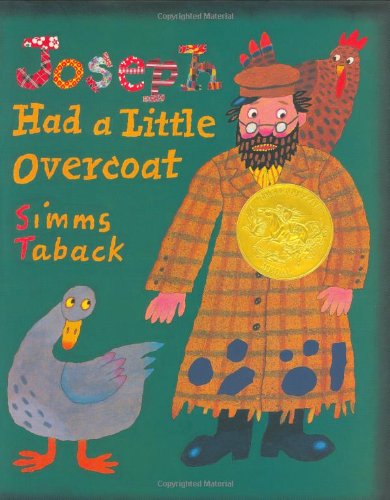
JOSEPH HAD A LITTLE OVERCOAT by Simms Taback

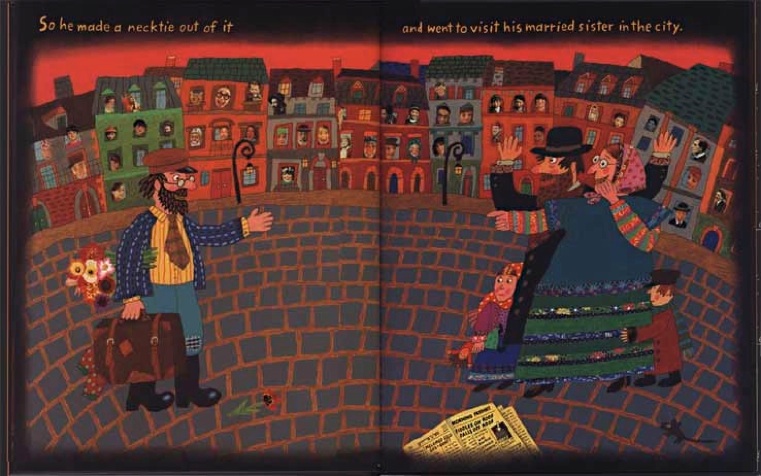
Joseph Had a Little Overcoat is based on a yiddish folk song called "I Had a Little Overcoat", which was one of Simms Taback's favorite songs as a child. The lyrics and music are reproduced in the back of the book. The main character, Joseph, is a resourceful man.  The sequential story describes what happens to Joseph's overcoat as it gets worn and old.  Instead of throwing the old coat away, Joseph makes it into a jacket.  The entertainment for the reader is predicting what Joseph will create next throughout his adventures.  


The illustrations and artwork are done using watercolor, Gouache (a type of painting designed to be opaque), pencil, ink, and collage.  Each page introduces the reader to new characters through the illustrations.  We meet animals on the farm surrounded by flowers constructed through collage.  Then we also meet some of Joseph's friends at a fair.  Each page is filled with artwork that is appealing to the eye.  As you turn the pages, the reader notices the pages are full of holes, just like Joseph's coat.  These die cuts on each page help the reader predict what Joseph will do with his coat next. 


The moral and theme to the story is one that is very refreshing in today's world, where too often we just throw things away when they get old.  The story proves that "you can always make something out of nothing... over and over again!" (Taback 1999).


Taback, Simms. 1999. Joseph Had a Little Overcoat. Illustrated by Simms Taback. 
New York: The Penguin Group. ISBN 0670878553

Awards:

Joseph Had a Little Overcoat earned the Caldecott Award Medal.

Classroom Connections:

After reading the book, have children find things around the house, such as buttons, scraps of old cloth, etc..., and using their imaginations, create something new.

Other books written and illustrated by Simms Taback:

There Was An Old Lady Who Swallowed A Fly, published by The Penquin Group, copyright 1997.

This is the House That Jack Built, published by Puffin, copyright 2004.

I Miss You Every Day, published by Viking Juvenile 2007

Reviews for Joseph Had a Little Overcoat

"A book bursting at the seams with ingenuity and creative spirit." -- School Library Journal

"Taback's mixed-media and collage illustrations are alive with warmth, humor, and humanity. Their colors are festive yet controlled, and they are filled with homey clutter, interesting characters, and a million details to bring children back again and again" -- Booklist

"This diverting, sequential story unravels as swiftly as the threads of Joseph's well-loved, patch-covered plaid coat. A flip of the page allows children to peek through to subsequent spreads as Joseph's tailoring produces items of decreasing size." -- Publisher's Weekly