Pages

background

Sunday, April 26, 2015

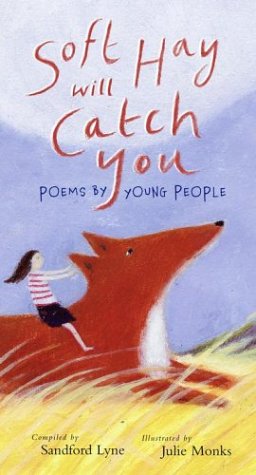
SOFT HAY WILL CATCH YOU compiled by Sanford Lyne

Poetry by Kids


Lyne, Sandford. 2004. SOFT HAY WILL CATCH YOU: POEMS BY YOUNG PEOPLE. New York: Simon & Schuster Books for Young Readers. ISBN 9780689834608


Compiled by Sandford Lyne, this book of poetry written by young people, is grouped into six different themes. Lyne collected the works while teaching poetry workshops at schools in a rural community in Kentucky. The categories of poems are of high interest to children grades 4th - 10th, and include loneliness, search for yourself, the soul's journey, discoveries, and home and family. Over one hundred young people's poetry appear in this compilation. Each young poet captures their theme and uses strong imagery. 

The poems vary in form and tone. Some are rhyming poems, others are free verse. The tone of the poems range from funny to serious, nonsense to fact, and silly to wise. The reader can find numerous poems that would appeal to their wants, as well as inspire them to write their own poetry. The poets vary in age as well, with poems written by elementary age students all the way to teenagers. The poems show the range of maturity with the topics chosen by the children writing. Some of the poems are about nature and family, while others are about the hardships of growing up. 

Julie Monks illustrates the book using oil paints. There are fourteen childlike illustrations throughout the book that truly capture the poems' meanings and will appeal to the reader. 

Spotlight Poem

MY KNIGHT

During class,
I wander off in my imagination.
I become the knight in shining armor
and slay the fearsome dragon.
Then with blood on my sword
and rust on my helmet
I become myself again,
back in class.

                     ~Andrew Schriebman
                       Grade 6


Classroom Activities

Every child has daydreamed during class at some point. Give children a moment to brainstorm about their daydream. You may even have them sketch a picture of their daydream.

After sharing the poem, have children write their own poem about their daydream.

Pair this poem with the picture book, My Pony by Susan Jeffers (Hyperion Books for Children, 2003). In this book the little girl daydreams about owning her own pony. 

Monday, April 20, 2015

FIREFLY JULY selected by Paul B. Janeczko

Janeczko Collection 


Janeczko, Paul B. 2014. FIREFLY JULY: A YEAR OF VERY SHORT POEMS. illustrated by Melissa Sweet. Somerville, MA: Candlewick Press. ISBN 9780763748428


Paul B. Janeczko selects 36 poems for this anthology grouped into the four seasons: spring, summer, fall, winter. Each poem is short in length, none more than 10 lines. You will find a variety of poets, with works from children's poets and a few adult poets. The subjects of the poems are mostly very simple objects, such as a water lily, a wheelbarrow, and a screen door. 

While these poems are very short in length, some only one sentence broken into several lines, the poems are packed with meaning and symbolism. I found myself reading the poems over and over again, and I admit it was hard for me to choose one to spotlight. These poems can find many places in the classroom and school libraries. The poems can be used in science, art, and social studies. I highly recommend this book for any classroom library or school library, elementary and middle school. 

Most of the poems in the book are free verse, a few rhyming. The selection of poems are perfectly fitting with the four seasons throughout the book. The poems use personification that enables the reader to really visualize the topic. One example is the poem, "Fog" by Carl Sandburg, where the fog "sits looking/ over the harbor and city". Imagery is also in abundance throughout the anthology. My favorite grouping of poems is the summer poems, where the reader can read about an orange cat, the moonlight, the sea, and a screen door. It made me think of my summer vacations and visiting my grandmother. 


The illustrations, by Melissa Sweet, are fancy and whimsical. The illustrations are done in watercolor, gouache, and mixed media. An example is the illustration accompanying the poem "Fog", which you can see above. The use of bright colors on the ships, where you typically wouldn't see bright colors, is so well done. This technique is used throughout the book. If you look closely, you can see the fog in the illustration depict the personification in the poem.  Do you see the cat sitting on top of the city? 


Spotlight Poem

The Red Wheelbarrow

so much depends
upon

a red wheel 
barrow

glazed with rain
water

beside the white
chickens.

~William Carlos Williams


Classroom Activities


"The Red Wheelbarrow" would be a fantastic introduction to a unit about the life of poets. After reading the poem, together research why William Carlos Williams wrote the poem and discuss the meaning it has behind the poem. Williams had an interesting life as a doctor, and many of his patients did not even know he was a poet. 


Use this poem in an art class, reading the poem and pausing to visualize the red wheel barrow, the rain, and the contrast of the white chickens. Students can paint what they visualize from the poem. This could also be an introduction to painting still objects in the art class. Students can choose an everyday object, such as a fork or cup, to paint, then write a poem about their painting.


Sunday, April 19, 2015

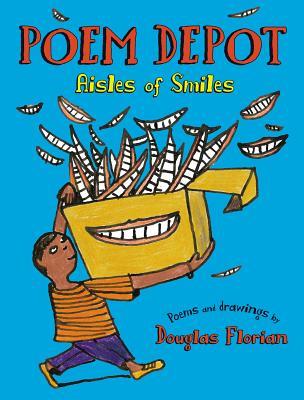
POEM DEPOT: AISLES OF SMILES by Douglas Florian

Current Poetry for Children


Florian, Douglas. 2014. POEM DEPOT: AISLES OF
SMILES. New York: Dial Books for Young Readers.
ISBN 9780803740426

The bestselling author of over fifty children's books, Douglas Florian, has written POEM DEPOT, a collection of hysterical poems. Organized into aisles, readers will find poems to tickle your ribs, with topics from alligators to Zero, and braces to windshield wipers. You can find a poem for every letter of the alphabet. Written in a style similar to Jack Prelutsky and Shel Silverstein, these 170 poems capture the humor of everyday life. 

The poems in POEM DEPOT vary in length, some only 4 lines, some longer. However, they are all short enough in length to be appealing to young readers. Every poem has a rhyme, but the rhyming patterns are different throughout the book. Florian uses a lot of word play in his poems, including similes, metaphors, and hyperboles. Each poem will bring giggles and laughter, but also open up the opportunity for classroom discussion and challenge students to think. 

The illustrations are drawn by Douglas Florian in dark, thick ink. Illustrations are on each page of the book, but are not overwhelming. Instead they add character and humor to the poems. Even though they are not in color, the boldness of the drawings make the reader pause and take in the pictures. 


The book includes a table of contents naming the title of each "aisle", or chapter. The poems are organized into aisles, such as "Tons of Puns" and "Jokes & Pokes & Funny Folks". At the back of the book, you will find two indexes. One index lists the titles of the poems, and the second index has the first line of each poem. 


Spotlight Poem


I'm So Hungry

I'm so hungry I could eat a horse,
And a moose, with a goose next course.
I'm so hungry I could eat Kentucky
And Rhode Island, Vermont, if I'm lucky.
I could eat the Earth with ease --
Except, of course, the peas, please. 


Classroom Activities


I'm So Hungry would be a great introduction to hyperboles. After reading, discuss what a hyperbole is, then have students write their own hyperboles. After writing a hyperbole, have students illustrate theirs similar to how Douglas Florian illustrates his poem. 

Teachers and librarians can find numerous poems in this compilation to introduce many topics throughout the school year. "Caterpillary" can be used to introduce a unit or science topic of life cycles. "In a Fog" can be used to teach idioms. 


Sunday, April 12, 2015

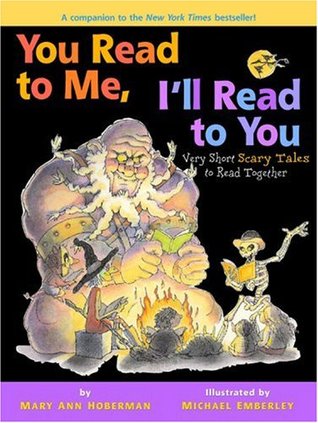
YOU READ TO ME, I'LL READ TO YOU

Poetry Performance

Hoberman, Mary Ann. 2007. YOU READ TO ME, I'LL READ
TO YOU: VERY SCARY TALES TO READ TOGETHER. illustrated
by Michael Amberley. New York: Little, Brown and Company. 
ISBN 9780316017336.


This is the fourth YOU READ TO ME installment of a series of poetry books by Mary Ann Doberman. In this fantastic collection of poems, children can read with a peer or adult about zombies, goblins, and ghouls. Perfect for Halloween, young readers will delight in the scary poems, which are in not scary in a way to keep children up at night. The monsters, witches, and goblins in the poems are amusing and delightful. The overall tone of the book is enjoyment and imaginative.  

The poems are meant for two readers, sometimes reading solo, while other times reading together. The lines are color coded, so that the reader knows when it is his/her time to read. A separate color is used for when both readers, or both groups are to read together. The lines are short enough that young readers will not become frustrated or lose interest. The rhythm and rhyme of the poem also will hold the interest of the young reader, and will aid in a struggling reader to decipher an unknown word. 

Mary Ann Doberman has teamed up with Michael Amberley in all the YOU READ TO ME poetry collections. Amberley uses pencil and watercolors to create hysterical monsters, ghouls, and phantoms. The illustrations give the monsters human like qualities, and they bring life to each poem. 

Spotlight Poem


The Ghost and the Mouse

 I am a ghost.            
            I am a mouse.
We live together
In this house.
            There's just one thing
            That's wrong, you see.
I'm scared of you.            
You're scared of me.            
            You're scared of me.
            I'm scared of you.
We know it's silly
But it's true.
            I'm scared of ghosts.
I'm scared of mice.            
To live together 
Isn't nice.
Each time I see a mouse,            
I shriek.            
            Each time I see a ghost,
            I squeak.
I wish that you            
Would move away.            
            I wish that you would move.
            I'll stay.


Classroom Activities


As you see, the poem is color coded.  The purple is for reader 1, the red for reader 2, and the orange is when the readers read in unison. This could also be done in as group 1 and group 2. 

This book would be a great companion for the month of October, since many children love Halloween. 

Reading buddies could be utilized with the poems in this book. Pair a young reader with an older reader, such as a first grader with a fifth grader.  The older reader can help the younger reader with unknown words. However, the rhyme and alliteration throughout the poems will help the young reader decode and learn language patterns. 

As readers go through the poems in the book, have children keep up with the rhyming pairs in a portable word wall. Whole class, or individual students, can begin making a rhyming dictionary. 

Friday, April 10, 2015

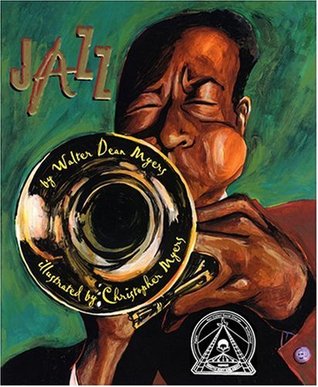
JAZZ by Walter Dean Myers

Lee Bennett Hopkins Poetry Award

Myers, Walter Dean. 2006. JAZZ. illustrated by Christopher Myers. New York: Holiday House. ISBN 9780823415458.

Beginning with an introduction and history of jazz, Walter Dean Myers presents various forms of jazz in poetic form.  Myers includes blues, modern jazz, ragtime, and swing. The poems in the book are beautifully written, with a two-tapping rhythm. While reading, you can feel the beat, and cannot help but move your body along with the words. JAZZ is a joyful celebration of the history of jazz and its beginnings in New Orleans. 

Christopher Myers illustrates the poems throughout the book using black ink and acrylic paints. The illustrator uses movements of the brush, along with the beats of the poems, make the illustrations come to life on the page. The colors are vibrant and exciting, something that children and adults will fall in love with. The font used in the poems play an important part of the book, as well. Words in the poems meant to be emphasized are larger, and in a curly style font. 

A glossary of jazz terms is included, giving definitions of words, such as chops, chord, fusion, and riff. Concluding the book is a "Jazz Time Line", starting with the 1800s in Congo Square, New Orleans. The time line then takes us through the Civil War and the first time that black musicians play for a white audience. 

The audio version of this book is sensational! Narrated by James 'D'Train' Williams and Vaneese Thomas, the book has backdrop of original jazz. The narrators sing and read the poems, setting the mood and tone. It is a beautiful combination of poetry and jazz. 


Spotlight Poem

OH, Miss Kitty

Oh, Miss Kitty,
she's as round as she is tall
I said Oh, Miss Kitty,
she's as round as she is tall
Ain't nothing about Miss Kitty
you would say is small

Dance, Miss Kitty
Dance till the break of dawn
You been dancing, Miss Kitty
Since the day that you were born

Oh, Miss Kitty
she's in love with the piano man

"Tickle them ivories, boy!"

Oh, Miss Kitty,
she's in love with the piano man

"Hit the white keys, too."

He's a slitty-eyed gangster
but plays like he got a plan

Dance, Miss Kitty
Dance till the break of dawn
You been dancing, Miss Kitty
Since the day that you were born


Classroom Activities

Play some samples of jazz music for the students and allow them to hear the rhythm.

After reading the above poem, or any poem in the book, stop and let students discuss the rhythm and sound they hear or see in their mind.

If you have access to the audio version, let students hear the performance of James 'D'Train' Williams and Vaneese Thomas.  Then, assign pairs or groups of students a poem from the book and have them read and perform the poem for the class. Consider allowing students to video their performances to show on the morning video announcements. 

Wednesday, April 8, 2015

THIS IS JUST TO SAY by Joyce Sidman

Sidman Poetry

Sidman, Joyce. 2007. THIS IS JUST TO SAY: POEMS OF APOLOGY AND FORGIVENESS. illustrated by Pamela Zagarenski. Boston: Houghton Mifflin Company. ISBN 9780618616800.

Mrs. Merz's sixth grade, fictional, class has been assigned to write "Sorry poems" as part of a poetry unit. The students end up liking their apology poems so much, they decide to put them together as a book. Anthony K., a sixth grader, writes the introduction, since it was his idea to include a second part of the book, the responses.

This is a very unique book. Written in various types of poems, some of the poems show sincere apology, some not apologetic at all. Some of the poems are light-hearted, but a few are very deep in meaning, with touchy subjects. The responses are interestingly written as well, with a response matching each original apology poem. Some of the poets were forgiven, but some were not. Just as the apology letters, some of the responses are humorous, while others touch on a subject that brings up deep feelings and emotions. For this reason, I recommend this poetry book for 5th grade and middle school grades. These poems of apology and forgiveness, or unforgiveness, are so well written, that the reader can sense the relationship between the two people.  Especially in one particular poem from a daughter to her absent father.

The illustrations are by Pamela Zagarenski in mixed media on paper and canvas. She uses a variety of collages and computer graphics to add illustrations to each poem throughout the book. The illustrations are magnificently done, delicately outlined paintings, with background done in collage of newspapers, notebook paper, paper bags, the sky, and even school supplies. The pictures are bright and colorful.

Spotlight Poem

to my Mom

Brownies -- Oops!

I smelled them from my room:
a wafting wave of chocolate-ness.

I listened for movement,
ears pricked like a bat's.

I crept down, stepped
over the sleeping dog.

I felt the cold linoleum
on my bare toes.

I saw the warm, thick 
brick of brownies.

I slashed a huge chunk
right out of the middle.

The gooey hunks of chocolate
winked at me as I gobbled them.

Afterward, the pan gaped
like an accusing eye.

My head said, Oops!
but my stomach said, Heavenly.

by Maria


Classroom Activities

Before reading this poem, allow children to discuss things they have done that would make their mom upset. 

Read the poem slowly, while children have their eyes closed, imagining the scent of the brownies, and the cold of the linoleum on the toes. 

Pair this poem with the response poem on p. 32, "Desk Mess -- Oops!" This is a response to Marla from Mom, who accidentally reads a note from Bobby while cleaning Marla's room. 

See and hear Joyce Sidman reading one of the poems from the book on her website.  http://www.joycesidman.com/books/this-is-just-to-say-poems/joyce-reads-to-manga-my.html

Now that the book has been read and introduced, have students choose someone to write their own apology poem to. 


Monday, March 30, 2015

THE LIGHTNING DREAMER by Margarita Engle

Biographical Poetry


Engle, Margarita. 2013. THE LIGHTNING DREAMER: CUBA'S GREATEST ABOLITIONIST. New York, NY: Houghton Mifflin Harcourt. ISBN 9780547807430

Set in a Spanish colony of Cuba in 1827, when the island was far from being free of slavery, penalties for run away slaves were harsh, and censorship was high. Margarita Engle, in her own words, tells the story of a bold woman, Gertrud Gómez de Avellaneda, who became a poet and one of the most daring and outspoken abolitionists of her time. Avellaneda, also known as Tula, falls in loves with stories, but is not allowed to go to school as girls were not allowed an education at this time in Cuba. Tula also belongs to an aristocrat family, who owns slaves, but is filled with guilt over the slaves in her family. Tula is expected to marry a rich, aristocrat man, but wants to marry for love. At the age of fourteen, Tula resists her arranged marriage. One day, she discovers banned books by a rebel poet. These poems speak deeply to Tula, and so begins her writing. 

Margarita Engle uses powerful words to write this novel in free verse about the life of Gertrud Gómez de Avellaneda (Tula), the Cuban feminist and abolitionist. While the novel is historical fiction, Engle researched the life of Tula carefully and included her references. The book is written in five parts, each part containing poems and taking place in a different year of Tula's life. The poems are titled by the name of the speaker, such as Tula, Manuel, and Caridad. All of these characters are someone special in Tula's life. The majority of the book is told from Tula's point of view, but it is more compelling, because we can see Tula through the eyes of these other characters. 

Even though there are no illustrations in the novel, Engle does an outstanding job with imagery and emotion, so that the reader can visualize the events and feel the emotions along with the characters. Even though this verse novel is set in the 1800s, many young people will be able to relate to the experiences. The book will stimulate various emotions, feelings, and moods.

Spotlight Poem

Tula

The only thing I can change
is myself. There is no way to alter
the orphans' loss, or my own 
sorrowful home.

Fourteen is such a cruel birthday.
My mother and grandfather are already planning
to auction me away
to the highest-bidding
rich man.

(excerpt from THE LIGHTNING DREAMER by Margarita Engle)

Classroom Activities

For a text to self connection, prior to reading the poem, have students discuss or write about what it is like to be fourteen. After reading the poem, have them compare their life to Tula's life at fourteen.  Why does Tula say that "Fourteen is a cruel birthday"?

This novel would be a perfect novel to go along with study of the 19th century abolitionist movement.  The reading teacher, Social Studies teacher, and librarian can collaborate to plan for inquiry for the students to find out more about Avellaneda and other abolitionist.

Students could find cultures where arranged marriages still happen and discuss. 


Awards for THE LIGHTNING DREAMER

Teaching for Change 2013 Favorite
Best 15 Latino Children's Books for 2013
ALSC Notable Children's Book for 2013
2014 Notable Trade Books for Social Studies
2014 Pura Belpré Honor Book


Friday, March 27, 2015

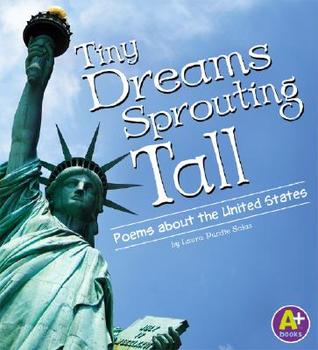
TINY DREAMS SPROUTING TALL by Laura Purdie Salas

Poetry for Social Studies


Salas, Laurie Purdie. 2008. TINY DREAMS SPROUTING TALL: POEMS ABOUT
THE UNITED STATES. Mankato, Minnesota: Capstone Press. ISBN 9781429612081


In the younger grades, a large part of Social Studies is learning about the symbols and landmarks of America. TINY DREAMS SPROUTING TALL is a collection of fifteen original poems by Laura Purdie Salas featuring objects, places, or people found around the United States. It has a range of topics, from the Statue of Liberty, the Bald Eagle, the Grand Canyon, Jazz, and Martin Luther King, Jr.  Salas has included a variety of forms of poetry throughout the book, some rhyming, others free verse. Salas writes a cinquain, an acrostic, a limerick, and a diamante in this book of poems. The poems are easy and fun to read, however, the simplicity is powerful throughout the book. Even though the poems are short and simple, they are packed with imagery and opportunity for discussion in the younger grade Social Studies class.

The book uses colorful photographs throughout, which are credited on the copyright page. The gorgeous photographs compliment each poem, showing the eagle soaring and the beauty of the Grand Canyon. The photographs are large and will be interesting to children.

Definitions for the different types of poems, along with the page numbers each type of poem can be found, are located at the end of the book. The book also includes a page defining a few poetry words, such as alliteration and rhythm. Some of the advanced words throughout the book are defined in an included glossary. This book will be very helpful for young readers, and a great compliment to a Social Studies unit.

Spotlight Poem


Lady Liberty

Liberty carries a golden torch
She wears a copper skin
She's broken free of all her chains 
and sways upon the wind


Classroom Activities


After introducing the poem, have students practice reading the poem aloud. Students can make props, such as a Lady Liberty crown, to use while performing the poem. 

Have students create a video, using iMovie, Animoto, or Photo Story, highlighting symbols, people, or landmarks of America. Students should include a reading of a poem from the book about the object, person, or place they will make the movie about. 


Sunday, March 22, 2015

A STRANGE PLACE TO CALL HOME by Marilyn Singer

Science Poetry


Singer, Marilyn. 2012. A STRANGE PLACE TO CALL HOME: THE WORLD'S MOST DANGEROUS HABITATS & THE ANIMALS THAT CALL THEM HOME. illustrated by Ed Young. San Fransisco, CA: Chronicle Books. ISBN 9781452101200.


This collection of fourteen poems give the reader a look at relatively unknown creatures, that live in extreme habitats, and who have adapted to challenging conditions. Each poem features a specific animal and the habitat in which it dwells. The reader will find a penguin that lives in a dessert, a monkey who loves the snow, and a blind albino fish living in a dark cave. After reading the poems in this collection, the reader will be anxious to learn more about these animals featured, and their extreme habitats.

Marilyn Singer uses various forms of poetry throughout the book to highlight the strange creatures and their harsh environments. Singer includes free verse, triolets, haiku, sonnet, cinquain, villanelle, and terza rima poems in this collection. In the back of the book is included a list of each poem and the form it is written in. Each poem is unique in its own way, and has a distinctive rhythm that will appeal to many ages of children. Since the topic of these poems are animals that will be unknown to many children, the poems will stimulate curiosity.

The illustrations in A STRANGE PLACE TO CALL HOME are created by Ed Young, winner of the Caldecott Medal. Young uses torn paper collage to create to astonishing illustrations that accompany each poem. Young's use of the torn paper depicts the movements of the animals, as well as the harshness of the habitat.

Spotlight Poem


CITY LIVING
urban foxes

They have
quiet forests and 
fields for sheds, flowerbeds;
forfeited wild berries for shrimp
lo mein.

It seems
an easy life,
but in close quarters, cars,
capture, and contagion take
their toll.

Foxes
adapted to
city living find it
full of plenty--but plentiful
in risk. 


Classroom Activities


This poem can be a start of discussions of how humans have changed animals habitats. Discuss why many foxes now live in urban areas, instead of in the forests. Have a class discussion of the risks that urban foxes face that Singer refers to in the last stanza of her poem. 

All of the poems in this collection could accompany a science unit for habitats or adaptation. The teacher or librarian could assign groups a poem, and the students would be responsible for finding more information about the highlighted animal. After completing the inquiry, students should be allowed to share with the class their poem and facts about the animal. 

The poems are written in various forms, some of them strict forms that have been given names. With the class, go to the Poetry Foundation glossary page that explains the poetry forms. After the students have learned about the forms of poetry included in the book, allow them to choose their favorite form and write their own poem about an animal. 

Sunday, March 1, 2015

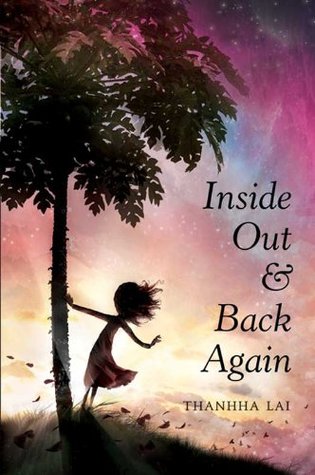
INSIDE OUT AND BACK AGAIN by Thanhha Lai

Verse Novel

Lai, Thanhha. 2011. INSIDE OUT & BACK AGAIN. New York: HarperCollins Publishers. ISBN 9780061962783.


Summary


Inside Out & Back Again is a novel in verse narrated by a ten year old girl, Hà, who lives in Saigon. The markets and traditions of Saigon is all she has known her whole life, and all her friends are here in Saigon. The Vietnam War has come to her home, and her family must flee their home. They are forced to choose only what will fit into a small bag to take with them. Hà and her family board a ship, along with hundreds of other refugees, and head toward their new life and new hope. 

The verse novel takes us through a year of change for Hà and her family as they try to make a new home for themselves in Alabama. They are met with coldness from their neighbors, and Hà and her brothers are left out at school. Hà hates this new land and the food at first, but she learns to lean on her family and trust friends. 

Critical Analyses


Inside Out & Back Again is beautifully written and evokes numerous sensory images. Hà's favorite food is the papaya, and throughout the book the reader can taste and feel the papaya with the sensory images that Thanhha Lai uses. The poetic form of the book is almost a must for this story, and I don't think it would be as good written in prose. The lines pause in perfect timing, so that the reader is forced to pause and take in the words. The short chapters/poems will be appealing to the young adult reader, however, even though the chapters are short they are packed with meaning. Filled with metaphors and similes, the author artistically places Hà's joys, fears, and other emotions into the book. 

The novel is told in first person and in the present tense, so the reader is able to experience Hà's year of change through her own words. At the end of the book is included an author's note, and we find that the events in this book are events that happened to the author, Thanhha Lai.  

Spotlight Poem


Two More Papayas

I see them first.

Two green thumbs
that will grow into
orange-yellow delights
smelling of summer.

Middle sweet
between a mango and a pear.

Soft as a yam
gliding down
after three easy,
thrilling chews.

April 5


Classroom Activities

Prior to reading the above poem, show students papayas, or images of papaya trees. If possible, have small slices of papayas for students to eat. After reading the poem, discuss students favorite foods. If you have students that are from other countries, allow them to talk about foods they miss from their home country. 

Have the students write a poem of their favorite food, describing the look, feel, and taste of the food.

Before introducing the book, ask students what they already know about the Vietnam War. Show photographs from this era. Research the Vietnam War in great detail while reading this novel with your class. Have students find out the role of Ho Chi Minh and communism in the war. 

The novel begins and ends on Têt, the Vietnamese New Year. Add this day to the celebrations you have in class, and have students explore more about the celebration. Have discussions on how Hà's life has changed from one Têt to the next Têt. Then allow students to write about, or share in other ways, how they have changed in the past year and what their new wishes are for the coming year. 


Awards for INSIDE OUT & BACK AGAIN

National Book award for Young People's Literature 2011

John Newbery Award 2012


Saturday, February 28, 2015

GUYKU: A YEAR OF HAIKU FOR BOYS by Bob Raczka

Poetic Form

Raczka, Bob. 2010. GUYKU: A YEAR OF HAIKU FOR BOYS. illustrated by Peter Reynolds. Boston: Houghton Mifflin Books or Children. ISBN 9780547240039.


A collection of haikus, this picture book tells a story of boys playing outside throughout each season. With puddles to splash in the spring, fishing in the summer, jumping in the leaves in the fall, and having a swordfight with icicles in the winter, this book of haikus captures the special moments that kids can have in the outdoors.  The reader is taken through all four seasons with playful ideas and ways guys play when given only the outdoors and their imagination. 

A haiku is a poem, usually about nature, that has a 5/7/5 syllable pattern. Each haiku in this collection by Bob Raczka follows this syllable pattern, but since they are about guys in nature, Raczka calls them Guykus. The title is very fitting, as we follow guys all through the book having fun outdoors and appreciating nature. The poems are screaming to be read aloud, while the reader is outside of course. Filled with personification, the reader can see and feel the happenings of nature in the haikus. 

Peter Reynolds, who is also known for The Dot, illustrated each haiku with watercolors. The illustrations are a phenomenal accompaniment to the haikus. My favorite illustration in the book is of a 'guy' laying on the ground with his dog, studying the sky. The illustrations are not too bold, so do not take away from the meaning of the poem. They add just enough to help interpret the haiku. 


The book features a writing at the end of the book, both by Bob Raczka and Peter Reynolds of the reasons they wrote and illustrated GUYKU. 

Spotlight Poem

Winter must be here.
Every time I open my
mouth, a cloud comes out. 


Classroom Activities

With all the snow we are getting, I had to choose this haiku from the book. I took my class outside to feel the snow yesterday, and we hadn't been outside a minute when three of my boys were making clouds come out of their mouth. This started a conversation about why clouds were coming out of our mouths.  This haiku would have been wonderful to have when we went back inside. 

To introduce each season of poems, take the students outside to read the poem aloud. Be sure to pause after each line to get the effect of the syllable pattern.  

After introducing a haiku from the book, or the book as a whole, you must introduce your students to the website, www.GuykuHaiku.com. The website highlights four poems, one from each season, and has an animated illustration from the book. There is also an abundance of ideas for teaching children to write their own haiku. Included are printables with illustrations or borders to help spark ideas for the haikus. Children can submit their haikus to Bob Raczka, for possible spotlight on the website. You must show them the haiku gallery, with haikus written by children. 

Monday, February 23, 2015

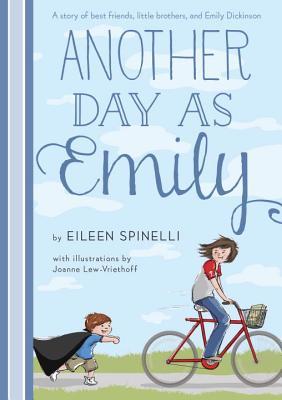
ANOTHER DAY AS EMILY by Eileen Spinelli

New Poetry for Children and Young Adults


Spinelli, Eileen. 2014. ANOTHER DAY AS EMILY. illustrations by Joanne Lew-Vriethoff. New York: Alfred A. Knopf. ISBN 9780449809877.

Another Day as Emily is a novel in verse by Eileen Spinelli for upper elementary and middle school grades. Eleven year old, Suzy, is the main character in this wonderful story. Her brother calls 911, when an elderly neighbor has "a spell". He becomes the local hero and Suzy finds herself jealous of the attention he is getting, especially when he ruins her birthday plans. Her best friend, Alison, is very different from Suzy, but they find themselves to be kindred spirits. Alison talks Suzy into trying out for a play, but when Alison gets a part and Suzy doesn't, Suzy finds herself more disappointed than she ever imagined. Suzy feels as if she is cast aside from many directions, and she finds solace in reading Emily Dickinson poems, and decides to live the same life that Emily lived. Suzy finds that being a recluse is more difficult than she thought. Will Suzy be able to continue this life with no friends and no outings?

Critical Analysis

Another Day as Emily is a new book, published in May of 2014, written in free verse. The short poems will be appealing to young readers, especially reluctant readers. Children, especially girls ages 8 to 12, will relate to the main character. Suzy faces many challenges that children face, such as jealousy of a younger sibling, a first crush, and fighting with your best friend. Emotions are high throughout the book, just like young girls' emotions. 

Many of the poems in the book are fabulous, filled with sensory images. When Suzy goes outside, the poems are beautifully written and create a world for the reader where we can even feel the wind that Suzy feels. For the most part, the poems have a rhythm, and pause at the end of the line in a natural way. The end of the lines have an effect on the reader to pause and take in the meaning and imagery of the words. However, there are a few poems/chapters in the book that are written choppy. Eileen Spinelli does a fabulous job of writing as a child and allowing the reader to see the mind of Suzy, the eleven year old. 

Spotlight Poem

Into the Breeze

It's a bright afternoon.
I ride my bike
into the warm breeze,
away from the house,
along the bike path.
Trees ripple green.
The light is golden.
The sky is blue.
And I am a bird
flying.....
flying.....
Alison doesn't know
what she's missing.

~Eileen Spinnelli


While reading this poem aloud, I would have children close their eyes and pretend they were on a bicycle. If it is a warm, sunny, day, I would take them outside to read the poem.

Classroom Connections

Reading Emily Dickinson poems would be a great connection to go with this book, especially "I'm Nobody, Who Are You?", which is mentioned several times in this book. 

There is a poem in the book titled, "Mrs. Harden's Treasure Box". After reading, have students draw items they would have if they had a treasure box. 

Another Day as Emily could accompany a history lesson, where students could research the dress and transportation back in the 1800s. There are numerous references to people and the dress during the time that Emily Dickinson was alive. There is a poem, "OH", where Suzy's dad gives her a history lesson on the bicycle and how only men could ride bicycles. This would be a great discussion starter for your classroom. 

Other Novels in Verse by Eileen Spinelli

WHERE I LIVE. 2007. Dial Books ISBN 9780803731226.
THE DANCING PANCAKE. 2010. Knopf Books for Young Readers. ISBN 9780375858703.
SUMMERHOUSE TIME. 2007. Knopf Books for Young Readers. ISBN 9780375840616. 


Saturday, February 14, 2015

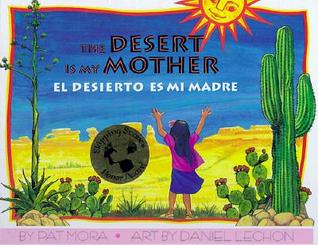
THE DESERT IS MY MOTHER by Pat Mora

Multicultural Poetry


Mora, Pat. 1994. THE DESERT IS MY MOTHER - EL DESIERTO ES MI MADRE. art by Daniel Lechon. Houston, TX: Piñata Books. ISBN 9781558851214.

A Skipping Stones Honor Award Book


Pat Mora is an award winning Latino poet and author. In this picture book, The Desert is My Mother, Pat Mora pairs up with the painter, Daniel Lechon, to create a story of Mother Nature. A young, dark haired girl narrates the poem describing the beauty of the desert and all it provides for her. Throughout the poem, the young girl invokes the powers of the desert, and the desert responds. The desert provides for her everything she needs, such as sun, water, life, and healing powers. The poem is written in English, translated in Spanish. As you turn the pages, a new stanza of the poem appears, with English on the top and the Spanish translation below.

The poem, by Pat Mora, is free verse, however follows a specific pattern throughout.  Each stanza begins with a short line, followed by a longer line. There is a definite rhythm found while reading the poem, making for a great read aloud for students working on fluency. Mora uses an abundance of metaphors and personification throughout this poem, creating a vivid image of the desert for the readers. Just like Mora's other award winning poems and books, this poem is brilliantly written.

The art in the book is created by Daniel Lechon, a prize-winning artist. Lechon adds to the imagery of the poem, illustrating the beauty of the desert, as well as the dreamy girl narrating the story. Lechon's illustrations show the expressions of the girl change through the story as the desert changes. When the desert provides her with rain, we see her joyful expression in the illustrations. When the desert yells out with thunder, the illustrations show her fear. The pictures of the girl are framed by a sand texture, adding to the imagery of the desert.

Spotlight Poem


I say frighten me.
She shouts thunder, flashes lightning.

I say hold me.
She whispers, "Lie in my arms."

I say heal me.
She gives me chamomile, oregano, peppermint.

I say caress me.
She strokes my skin with her warm breath.

excerpt from THE DESERT IS MY MOTHER.

Classroom Connections


Many grade levels have habitats and environments included in their Science TEKS, and this book would be an excellent addition to this unit. After reading the poem, the students could choose a different environment to write a poem about. 

While reading the poem and introducing, play background music with desert sounds.  Then, replay the music while students write about what they hear. Then have them share in groups their thoughts and writings.

Since there are two lines in each stanza, you could have pairs, or groups, take turns reading the lines of the poem.

Pat Mora includes many actions in this poem, with many opportunities to teach personification. You could have students act out this poem while reading it. 


Friday, February 13, 2015

MIRROR MIRROR by Marilyn Singer

Singer, Marilyn. 2010. MIRROR MIRROR: A BOOK OF
REVERSIBLE VERSE. illustrated by Josée Masse.
New York: Dutton Children's Books. ISBN 9780525479017
NCTE Award winning poet, Marilyn Singer


Marilyn Singer combines poetry with fairy tales in this amazing book of reversible poems. It is the first I have seen of this type of poetry. Classic, popular fairy tales are included, such as Snow White, Rapunzel, Cinderella, and Sleeping Beauty. Each poem shows two sides of the story, from the princess' points of view and even sometimes the wicked stepmother's point of view. 

This book is ingenious! I read it to my nine year old daughter, and her jaw dropped after the first poem.  It is amazing that the poems are read from top to bottom, then the reader can flip the poem, reading it up the page. The poems are reverse images of themselves, and tell a story in both directions. The most amazing thing about the poems is that even though they are mirror images of themselves, the reverso poem tells the story from a different point of view. 

Throughout the picture book, there are 14 reverso poems. The reverse, or mirror image, of the poems are written in a different font and color, which helps distinguish the poems. The reverse of the poems allow for punctuation, capitalization, and line break changes. A few of the poems are written in rhyme, but most are free verse. There are two poems that were hard to find a rhythm while reading, but overall, the poems are full of rhythm.

The illustrations, by Josée Masse, are absolutely fabulous. The colors used are vibrant and fun. The illustrations, just like the poems, are drawn in a split image, showing the two characters that are narrating the poems. 

Spotlight Poem

Bears in the News

ASLEEP IN CUB'S BED,
BLONDE
STARTLED BY
BEARS,
the headline read.
Next day
Goldilocks claimed,
"They shouldn't have left
the door
unlocked."
She
ate the porridge.
She
broke
a chair.
"Big deal?
No!
They weren't there."

They weren't there.
No
big deal?!
A chair
broke.
She
ate the porridge.
She 
unlocked 
the door.
"They shouldn't have left,"
Goldilocks claimed.
Next day
the headline read:
BEARS STARTLED
BY BLONDE
ASLEEP IN CUB'S BED.

excerpt from MIRROR MIRROR.


Classroom Connections


This book of reverso poems would be an incredible addition to any fairy tale unit, especially if you are reading fractured fairy tales and comparing them.

After introducing the above poem, Bears in the News, have students look at editorial pieces in newspapers that are written from different perspectives. Then have the students get into groups and decide if they will write from Goldilocks's or the Bears' point of view, and have them write an editorial for the newspaper.

Later, you could have them do the same for other fairy tales, such as The Three Little Pigs, writing from the pigs' or the wolf's perspective. You could incorporate technology, and teach the students to type in a two column format. 

Challenge your students, and yourself, to write a reverso poem!

A Fun Fact

Marilyn Singer wrote a poem about her cat that could be read up and down. She did this just for fun. She had such a good time composing it, that she challenged herself to write more reverso poems. 


Thursday, February 5, 2015

DINOTHESAURUS by Douglas Florian


Florian Poetry


Florian, Douglas. 2009. DINOTHESAURUS. New York, NY: Atheneum Books. ISBN
9781416979784


DINOTHESAURUS is a compilation of poems by Douglas Florian with fun facts about 18 different dinosaurs. Beginning with the Brachiosaurus, you will find humorous, witty poems including the popular T-Rex, Iguanodon, and Triceratops. This anthology is a must for any dinosaur fan. Each poem provides facts about the dinosaur in a fun, rhyming manner. Douglas Florian brings the dinosaurs to life with words and art.

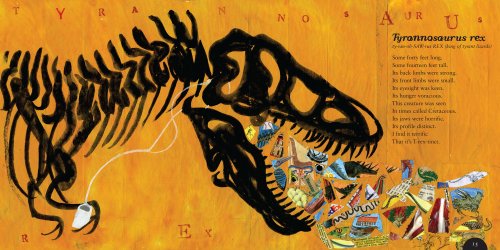
Florian is the illustrator in this compilation, as well as the poet. The illustrations are collages completed onto brown paper bags. They consist of colored pencils, water colors, collage, stencils, and stamps. The illustration accompanying the poem, Tyronnosaurus rex, is very vivid. Florian uses newspaper and magazine cuttings to create a collage depicting items the T-Rex possibly had eaten. The collage type illustrations are soft and fun, different from the bold, sometimes scary, illustrations of dinosaurs often found in books.


Each poem provides the pronunciation of the dinosaur names, as well as the meaning of the name. There is a table of contents at the front of the book to help find each poem, and a 'Glossarysaurus' at the back of the book. This provides more information and facts on each dinosaur.  There is even a drawing of Mr. Florian as a dinosaur himself. 

The following is an excerpt from DINOTHESAURUS that depicts Florian's use of rhyme, rhythm, and humor. 

Barosaurus

I'm higher than five elephants.
I'm longer than most whales.
My giant neck is balanced by
My forty-three-foot tail.
A tail that is my weapon.
It swings from side to side.
From nose to tail I'm ninety feet --
Hey kid, ya wanna ride?

Classroom Connections

This book would be an excellent addition to any school library for classroom use during a dinosaur or poetry unit. The teacher can start out with a KWL chart showing what the students already know about dinosaurs. 

After reading, each student can choose a poem to act out. Douglas Florian uses lots of action in his poems throughout this book, so it would be fun for students to act out their dinosaur. 

The class could discuss the illustrations and how each shows details provided in the poem. Some of the details will be hard to find, so this can be a fun hunt and find activity for your class. Consider placing the illustrations on the projector so that the whole class can see. 


Tuesday, January 27, 2015

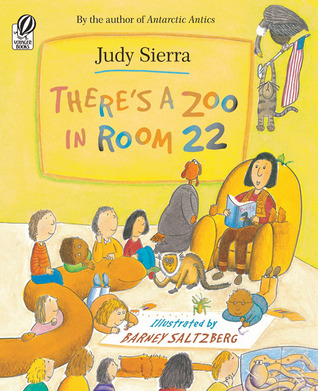
THERE'S A ZOO IN ROOM 22 by Judy Sierra

School Poetry


Sierra, Judy. 2000. THERE'S A ZOO IN ROOM 22. illustrated by Barney Salzburg. San Diego, CA: Gulliver Book Harcourt, Inc. ISBN 9780152020330.   


The students in Room 22 ask their teacher, Miss Darling, for a class pet. The kids in Room 22 have a very special teacher, for instead of just one pet, she gives them a whole pet alphabet. From Anaconda Amanda to a zorilla, the students and Miss Darling have a zoo in their classroom by the end of this book. This poetry book is a must-have for a school library, and a great read aloud.  The students will laugh out loud at the antics in the book. The best part.... finding out at the end what a zorilla is. 

Each letter of the alphabet gets it owns poem in this book. All the poems are rhyming poems, and with the familiar rhythm and topic, they will all appeal to young children. Many of the poems have an AB rhyming pattern, but a few have different patterns, such as an AAAB rhyming pattern. The poems are also filled with alliteration.

The poems are laid out in alphabetical order, with each poem getting its own page. The illustrator, Barney Salzburg, uses pencils and watercolors to create cartoon illustrations. The illustrations truly add humor to the poems. For example, the poem "Return to Sender: Jaguarundi", has a detailed illustration showing the jaguar attempting to escape from his box.  You can also see the children and other animals from previous pages peeking out the school windows. 

Spotlight Poem 

Iggy Iguana

Meg put Iggy on her shoulder -- 
He's a super shoulder holder.
Moments later, he grew bolder,
And he climbed up on her head.

Now begins the part that's creepy --
Our iguana, feeling sleepy,
Made Meg's hair into a teepee,
And her head is now his bed.

Activities

The above poem is my favorite from the book THERE'S A ZOO IN ROOM 22. I think for young students, especially Pre-K and K, you could start off by singing the song, "Head, Shoulder, Knees, and Toes." 

While most children's poems have an ABAB rhyming pattern, this poem has a different pattern. After reading the poem a few times, have students identify the rhyming words. Students can even name the rhyming pattern in the poem.

A post reading activity for the entire book would be for the class to make their own alphabet poetry book. The topic could be pets, just like in this book, or you could have the students choose another topic. Wild animals or zoo animals would be a good topic.