Pages

background

Sunday, April 26, 2015

SOFT HAY WILL CATCH YOU compiled by Sanford Lyne

Poetry by Kids


Lyne, Sandford. 2004. SOFT HAY WILL CATCH YOU: POEMS BY YOUNG PEOPLE. New York: Simon & Schuster Books for Young Readers. ISBN 9780689834608


Compiled by Sandford Lyne, this book of poetry written by young people, is grouped into six different themes. Lyne collected the works while teaching poetry workshops at schools in a rural community in Kentucky. The categories of poems are of high interest to children grades 4th - 10th, and include loneliness, search for yourself, the soul's journey, discoveries, and home and family. Over one hundred young people's poetry appear in this compilation. Each young poet captures their theme and uses strong imagery. 

The poems vary in form and tone. Some are rhyming poems, others are free verse. The tone of the poems range from funny to serious, nonsense to fact, and silly to wise. The reader can find numerous poems that would appeal to their wants, as well as inspire them to write their own poetry. The poets vary in age as well, with poems written by elementary age students all the way to teenagers. The poems show the range of maturity with the topics chosen by the children writing. Some of the poems are about nature and family, while others are about the hardships of growing up. 

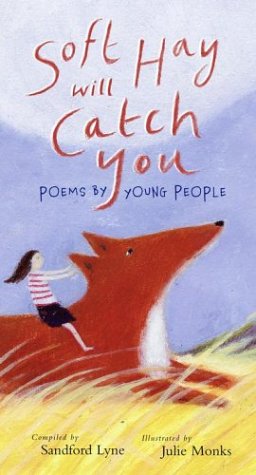
Julie Monks illustrates the book using oil paints. There are fourteen childlike illustrations throughout the book that truly capture the poems' meanings and will appeal to the reader. 

Spotlight Poem

MY KNIGHT

During class,
I wander off in my imagination.
I become the knight in shining armor
and slay the fearsome dragon.
Then with blood on my sword
and rust on my helmet
I become myself again,
back in class.

                     ~Andrew Schriebman
                       Grade 6


Classroom Activities

Every child has daydreamed during class at some point. Give children a moment to brainstorm about their daydream. You may even have them sketch a picture of their daydream.

After sharing the poem, have children write their own poem about their daydream.

Pair this poem with the picture book, My Pony by Susan Jeffers (Hyperion Books for Children, 2003). In this book the little girl daydreams about owning her own pony. 

Monday, April 20, 2015

FIREFLY JULY selected by Paul B. Janeczko

Janeczko Collection 


Janeczko, Paul B. 2014. FIREFLY JULY: A YEAR OF VERY SHORT POEMS. illustrated by Melissa Sweet. Somerville, MA: Candlewick Press. ISBN 9780763748428


Paul B. Janeczko selects 36 poems for this anthology grouped into the four seasons: spring, summer, fall, winter. Each poem is short in length, none more than 10 lines. You will find a variety of poets, with works from children's poets and a few adult poets. The subjects of the poems are mostly very simple objects, such as a water lily, a wheelbarrow, and a screen door. 

While these poems are very short in length, some only one sentence broken into several lines, the poems are packed with meaning and symbolism. I found myself reading the poems over and over again, and I admit it was hard for me to choose one to spotlight. These poems can find many places in the classroom and school libraries. The poems can be used in science, art, and social studies. I highly recommend this book for any classroom library or school library, elementary and middle school. 

Most of the poems in the book are free verse, a few rhyming. The selection of poems are perfectly fitting with the four seasons throughout the book. The poems use personification that enables the reader to really visualize the topic. One example is the poem, "Fog" by Carl Sandburg, where the fog "sits looking/ over the harbor and city". Imagery is also in abundance throughout the anthology. My favorite grouping of poems is the summer poems, where the reader can read about an orange cat, the moonlight, the sea, and a screen door. It made me think of my summer vacations and visiting my grandmother. 


The illustrations, by Melissa Sweet, are fancy and whimsical. The illustrations are done in watercolor, gouache, and mixed media. An example is the illustration accompanying the poem "Fog", which you can see above. The use of bright colors on the ships, where you typically wouldn't see bright colors, is so well done. This technique is used throughout the book. If you look closely, you can see the fog in the illustration depict the personification in the poem.  Do you see the cat sitting on top of the city? 


Spotlight Poem

The Red Wheelbarrow

so much depends
upon

a red wheel 
barrow

glazed with rain
water

beside the white
chickens.

~William Carlos Williams


Classroom Activities


"The Red Wheelbarrow" would be a fantastic introduction to a unit about the life of poets. After reading the poem, together research why William Carlos Williams wrote the poem and discuss the meaning it has behind the poem. Williams had an interesting life as a doctor, and many of his patients did not even know he was a poet. 


Use this poem in an art class, reading the poem and pausing to visualize the red wheel barrow, the rain, and the contrast of the white chickens. Students can paint what they visualize from the poem. This could also be an introduction to painting still objects in the art class. Students can choose an everyday object, such as a fork or cup, to paint, then write a poem about their painting.


Sunday, April 19, 2015

POEM DEPOT: AISLES OF SMILES by Douglas Florian

Current Poetry for Children


Florian, Douglas. 2014. POEM DEPOT: AISLES OF
SMILES. New York: Dial Books for Young Readers.
ISBN 9780803740426

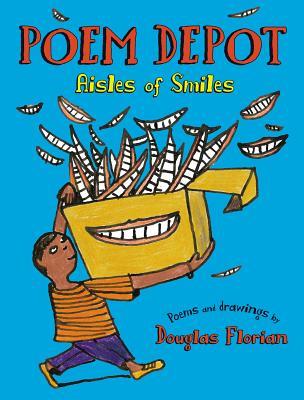
The bestselling author of over fifty children's books, Douglas Florian, has written POEM DEPOT, a collection of hysterical poems. Organized into aisles, readers will find poems to tickle your ribs, with topics from alligators to Zero, and braces to windshield wipers. You can find a poem for every letter of the alphabet. Written in a style similar to Jack Prelutsky and Shel Silverstein, these 170 poems capture the humor of everyday life. 

The poems in POEM DEPOT vary in length, some only 4 lines, some longer. However, they are all short enough in length to be appealing to young readers. Every poem has a rhyme, but the rhyming patterns are different throughout the book. Florian uses a lot of word play in his poems, including similes, metaphors, and hyperboles. Each poem will bring giggles and laughter, but also open up the opportunity for classroom discussion and challenge students to think. 

The illustrations are drawn by Douglas Florian in dark, thick ink. Illustrations are on each page of the book, but are not overwhelming. Instead they add character and humor to the poems. Even though they are not in color, the boldness of the drawings make the reader pause and take in the pictures. 


The book includes a table of contents naming the title of each "aisle", or chapter. The poems are organized into aisles, such as "Tons of Puns" and "Jokes & Pokes & Funny Folks". At the back of the book, you will find two indexes. One index lists the titles of the poems, and the second index has the first line of each poem. 


Spotlight Poem


I'm So Hungry

I'm so hungry I could eat a horse,
And a moose, with a goose next course.
I'm so hungry I could eat Kentucky
And Rhode Island, Vermont, if I'm lucky.
I could eat the Earth with ease --
Except, of course, the peas, please. 


Classroom Activities


I'm So Hungry would be a great introduction to hyperboles. After reading, discuss what a hyperbole is, then have students write their own hyperboles. After writing a hyperbole, have students illustrate theirs similar to how Douglas Florian illustrates his poem. 

Teachers and librarians can find numerous poems in this compilation to introduce many topics throughout the school year. "Caterpillary" can be used to introduce a unit or science topic of life cycles. "In a Fog" can be used to teach idioms. 


Sunday, April 12, 2015

YOU READ TO ME, I'LL READ TO YOU

Poetry Performance

Hoberman, Mary Ann. 2007. YOU READ TO ME, I'LL READ
TO YOU: VERY SCARY TALES TO READ TOGETHER. illustrated
by Michael Amberley. New York: Little, Brown and Company. 
ISBN 9780316017336.


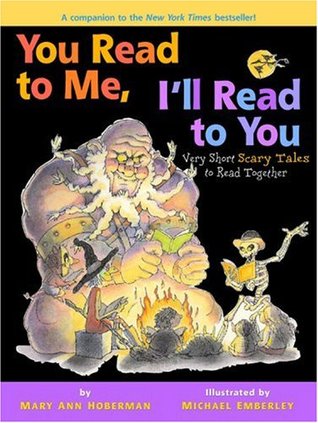
This is the fourth YOU READ TO ME installment of a series of poetry books by Mary Ann Doberman. In this fantastic collection of poems, children can read with a peer or adult about zombies, goblins, and ghouls. Perfect for Halloween, young readers will delight in the scary poems, which are in not scary in a way to keep children up at night. The monsters, witches, and goblins in the poems are amusing and delightful. The overall tone of the book is enjoyment and imaginative.  

The poems are meant for two readers, sometimes reading solo, while other times reading together. The lines are color coded, so that the reader knows when it is his/her time to read. A separate color is used for when both readers, or both groups are to read together. The lines are short enough that young readers will not become frustrated or lose interest. The rhythm and rhyme of the poem also will hold the interest of the young reader, and will aid in a struggling reader to decipher an unknown word. 

Mary Ann Doberman has teamed up with Michael Amberley in all the YOU READ TO ME poetry collections. Amberley uses pencil and watercolors to create hysterical monsters, ghouls, and phantoms. The illustrations give the monsters human like qualities, and they bring life to each poem. 

Spotlight Poem


The Ghost and the Mouse

 I am a ghost.            
            I am a mouse.
We live together
In this house.
            There's just one thing
            That's wrong, you see.
I'm scared of you.            
You're scared of me.            
            You're scared of me.
            I'm scared of you.
We know it's silly
But it's true.
            I'm scared of ghosts.
I'm scared of mice.            
To live together 
Isn't nice.
Each time I see a mouse,            
I shriek.            
            Each time I see a ghost,
            I squeak.
I wish that you            
Would move away.            
            I wish that you would move.
            I'll stay.


Classroom Activities


As you see, the poem is color coded.  The purple is for reader 1, the red for reader 2, and the orange is when the readers read in unison. This could also be done in as group 1 and group 2. 

This book would be a great companion for the month of October, since many children love Halloween. 

Reading buddies could be utilized with the poems in this book. Pair a young reader with an older reader, such as a first grader with a fifth grader.  The older reader can help the younger reader with unknown words. However, the rhyme and alliteration throughout the poems will help the young reader decode and learn language patterns. 

As readers go through the poems in the book, have children keep up with the rhyming pairs in a portable word wall. Whole class, or individual students, can begin making a rhyming dictionary. 

Friday, April 10, 2015

JAZZ by Walter Dean Myers

Lee Bennett Hopkins Poetry Award

Myers, Walter Dean. 2006. JAZZ. illustrated by Christopher Myers. New York: Holiday House. ISBN 9780823415458.

Beginning with an introduction and history of jazz, Walter Dean Myers presents various forms of jazz in poetic form.  Myers includes blues, modern jazz, ragtime, and swing. The poems in the book are beautifully written, with a two-tapping rhythm. While reading, you can feel the beat, and cannot help but move your body along with the words. JAZZ is a joyful celebration of the history of jazz and its beginnings in New Orleans. 

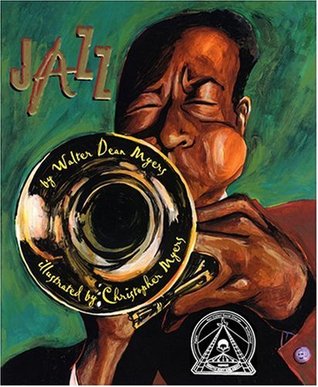
Christopher Myers illustrates the poems throughout the book using black ink and acrylic paints. The illustrator uses movements of the brush, along with the beats of the poems, make the illustrations come to life on the page. The colors are vibrant and exciting, something that children and adults will fall in love with. The font used in the poems play an important part of the book, as well. Words in the poems meant to be emphasized are larger, and in a curly style font. 

A glossary of jazz terms is included, giving definitions of words, such as chops, chord, fusion, and riff. Concluding the book is a "Jazz Time Line", starting with the 1800s in Congo Square, New Orleans. The time line then takes us through the Civil War and the first time that black musicians play for a white audience. 

The audio version of this book is sensational! Narrated by James 'D'Train' Williams and Vaneese Thomas, the book has backdrop of original jazz. The narrators sing and read the poems, setting the mood and tone. It is a beautiful combination of poetry and jazz. 


Spotlight Poem

OH, Miss Kitty

Oh, Miss Kitty,
she's as round as she is tall
I said Oh, Miss Kitty,
she's as round as she is tall
Ain't nothing about Miss Kitty
you would say is small

Dance, Miss Kitty
Dance till the break of dawn
You been dancing, Miss Kitty
Since the day that you were born

Oh, Miss Kitty
she's in love with the piano man

"Tickle them ivories, boy!"

Oh, Miss Kitty,
she's in love with the piano man

"Hit the white keys, too."

He's a slitty-eyed gangster
but plays like he got a plan

Dance, Miss Kitty
Dance till the break of dawn
You been dancing, Miss Kitty
Since the day that you were born


Classroom Activities

Play some samples of jazz music for the students and allow them to hear the rhythm.

After reading the above poem, or any poem in the book, stop and let students discuss the rhythm and sound they hear or see in their mind.

If you have access to the audio version, let students hear the performance of James 'D'Train' Williams and Vaneese Thomas.  Then, assign pairs or groups of students a poem from the book and have them read and perform the poem for the class. Consider allowing students to video their performances to show on the morning video announcements. 

Wednesday, April 8, 2015

THIS IS JUST TO SAY by Joyce Sidman

Sidman Poetry

Sidman, Joyce. 2007. THIS IS JUST TO SAY: POEMS OF APOLOGY AND FORGIVENESS. illustrated by Pamela Zagarenski. Boston: Houghton Mifflin Company. ISBN 9780618616800.

Mrs. Merz's sixth grade, fictional, class has been assigned to write "Sorry poems" as part of a poetry unit. The students end up liking their apology poems so much, they decide to put them together as a book. Anthony K., a sixth grader, writes the introduction, since it was his idea to include a second part of the book, the responses.

This is a very unique book. Written in various types of poems, some of the poems show sincere apology, some not apologetic at all. Some of the poems are light-hearted, but a few are very deep in meaning, with touchy subjects. The responses are interestingly written as well, with a response matching each original apology poem. Some of the poets were forgiven, but some were not. Just as the apology letters, some of the responses are humorous, while others touch on a subject that brings up deep feelings and emotions. For this reason, I recommend this poetry book for 5th grade and middle school grades. These poems of apology and forgiveness, or unforgiveness, are so well written, that the reader can sense the relationship between the two people.  Especially in one particular poem from a daughter to her absent father.

The illustrations are by Pamela Zagarenski in mixed media on paper and canvas. She uses a variety of collages and computer graphics to add illustrations to each poem throughout the book. The illustrations are magnificently done, delicately outlined paintings, with background done in collage of newspapers, notebook paper, paper bags, the sky, and even school supplies. The pictures are bright and colorful.

Spotlight Poem

to my Mom

Brownies -- Oops!

I smelled them from my room:
a wafting wave of chocolate-ness.

I listened for movement,
ears pricked like a bat's.

I crept down, stepped
over the sleeping dog.

I felt the cold linoleum
on my bare toes.

I saw the warm, thick 
brick of brownies.

I slashed a huge chunk
right out of the middle.

The gooey hunks of chocolate
winked at me as I gobbled them.

Afterward, the pan gaped
like an accusing eye.

My head said, Oops!
but my stomach said, Heavenly.

by Maria


Classroom Activities

Before reading this poem, allow children to discuss things they have done that would make their mom upset. 

Read the poem slowly, while children have their eyes closed, imagining the scent of the brownies, and the cold of the linoleum on the toes. 

Pair this poem with the response poem on p. 32, "Desk Mess -- Oops!" This is a response to Marla from Mom, who accidentally reads a note from Bobby while cleaning Marla's room. 

See and hear Joyce Sidman reading one of the poems from the book on her website.  http://www.joycesidman.com/books/this-is-just-to-say-poems/joyce-reads-to-manga-my.html

Now that the book has been read and introduced, have students choose someone to write their own apology poem to.