Pages

background

Tuesday, April 29, 2014

RAPUNZEL'S REVENGE by Shannon and Dean Hale

A tale of Rapunzel, the girl with the extremely long hair, like you've never read before.  Rapunzel grows up with her mother, or who she thinks is her mother, in a castle surrounded by a very tall wall. Rapunzel is very curious to see what is on the other side of the wall, so one day she ventures out and climbs the wall. Mother Gothel finds out that she has ventured beyond the wall and locks Rapunzel in a tower, where her hair grows and grows.  Set in the wild west, Rapunzel and an outlaw, Jack, go on many adventures seeking Rapunzel's true mother.  
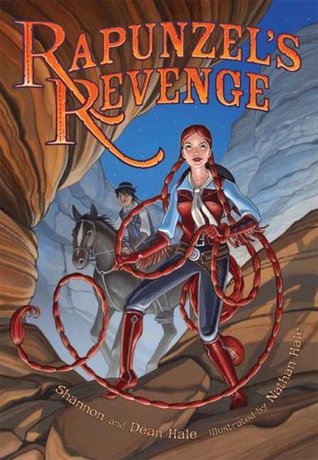

Hale, Shannon and Dale.  Rapunzel's Revenge. illustrated by Nathan Hale. New York: Bloomsbury USA Children's Books, 2008.  ISBN 9781599900704

In this graphic novel retelling of the fairy tale classic, Shannon and Dean Hale create a very strong feminine character who ends up being the heroine.  Rapunzel proves to be independent, smart, and saves the day.  The reader will have trouble putting this book down, waiting to find out how Rapunzel gets out of another dilemma.  The plot somewhat follows the classic fairy tale, but is set in the wild west with cowboys and horses.  The authors pack this graphic novel full of action and adventure on every page as Rapunzel seeks her true mother to save her from slavery and to overtake the cruel Mother Gothel from her magical powers.  

The illustrations throughout the graphic novel are marvelous and add emotion to the story. The illustrator, Nathan Hale, does a wonderful job of adding images that show action on every page.  Hale adds emotions in the characters' faces and the sequence of the illustrations helps the story flow.  Throughout the story, Rapunzel must use her ridiculously long hair as a weapon.  Without the detailed illustrations, the reader probably would not have a complete picture of this, however Nathan Hale illustrates Rapunzel's use of her hair magnificently and adds humor to the adventure.


Awards for Rapunzel's Revenge

ALA 2009 Notable Children's Book
YALSA 2009 Great Graphic Novel for Young Adults
Eisner Award Nominee
2011 Young Reader's Choice Award
Cybil Award Winner
ALA 2009 Popular Paperback

Reviews for Rapunzel's Revenge


"With its can-do heroine, witty dialogue and romantic ending, this graphic novel has something for nearly everybody."~ Publisher's Weekly

 "Readers familiar with graphic novels will feel at home...Newbies may not realize how particularly well-matched the Hales' gutsy tale is to its format, but this introduction--with its high action quotient, immediate sensory thrills, and wisecracking heroes--should win many converts. With such a successful debut, one hopes to see more graphic novels from this trio."~ Horn Book 

"Rich with humor and excitement, Rapunzel's Revenge is an alternate version of a classic that will become a fast favorite of young readers."~ Booklist

More Books by Shannon and Dean Hale, illustrated by Nathan Hale

Calamity Jack. New York: Bloomsbury USA Childrens, 2010.  ISBN  9781599903736

Books by Shannon Hale

The Goose Girl. New York: Bloomsbury USA Childrens, 2005.  ISBN 9781582349909
Book of a Thousand Days. New York: Bloomsbury USA Childrens, 2009. ISBN   9781599903781
Princess Academy.  New York: Bloomsbury USA Childrens, 2007.  ISBN   97881599900735

Classroom Connections

After reading, brainstorm other settings for a fairy tale, such as outer space or under the sea.  Then have students choose a fairy tale to rewrite with the new setting.  

Discuss general elements of a fairy tale.  Which elements does Rapunzel's Revenge have?  Compare/contrast Rapunzel's Revenge with the classic Rapunzel fairy tale. 

Collaborate with the history teacher and explore what life was really like in the "old west".  Discuss the illustrations by Nathan Hale and parts that are fanciful/fantasy and parts that are true to the "old west". 


Saturday, April 19, 2014

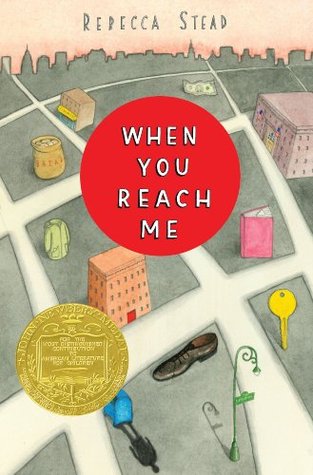
WHEN YOU REACH ME by Rebecca Stead

Book Design by Kate Gartner

Stead, Rebecca. When You Reach Me. New York: Wendy Lamb Books, 2009.  ISBN 9780385737425


Miranda is in the sixth grade and lives in New York City, 1979, in the same apartment building as her best friend Sal.  She is a "latch key kid" and is infatuated with the novel A Wrinkle in Time.  Sal and Miranda know the safe places in their neighborhood and they know who to avoid, such as the "laughing guy" who sleeps under a garbage can near their apartment building.  Then, one day, Miranda's life is turned around.  The extra key to her apartment comes up missing, Sal gets punched and decides they shouldn't be friends, and then Miranda receives mysterious letters.
"I am coming to save your friend's life, and my own."
Miranda realizes that whoever is leaving these notes knows details about her, but also things that have not happened yet.  She must find new friends and solve the mystery of the letters and find a way to stop the tragedy that is predicted.

When You Reach Me is a fantasy set in a realistic setting, or low fantasy.  The main character, Miranda, is realistic and much like a normal sixth grader.  Miranda is a strong character and the reader will relate to her immediately.  Miranda is also the narrator of the story, so the reader is able to hear her thoughts and point of view.  The plot is originally grounded in reality, then later moves into a  fantasy.  Everything is tied together and explained by the end of the book, so the reader is satisfied and any open questions are answered.  The reader will be intrigued with the adventures of Miranda and her friends through New York in the late 70s and they learn the importance of friendship and love.  While friendship is the major theme, the reader will also see topics, such as homelessness, single parenting, and jail discussed throughout the book.  Even though the story is told from Miranda's point of view, the author creates a distinct voice of each character through the story and makes the fantasy world believable to the reader.


AudioBook

An audio book is also available for When You Reach Me, narrated by Cynthia Holloway.  The reading is very strong and shows the emotions of Miranda throughout her journeys.  Holloway provides an excellent reading so that the listener is presented with Miranda's feelings and actions as she solves her mystery of the letters.

Stead, Rebecca. When You Reach Me. narrated by Cynthia Holloway.  Listening Library, 2009.  Overdrive MP3 Audiobook Unabridged Edition  ISBN 9780739380758


Awards for When You Reach Me

2010 John Newberry Medal
2010 Boston Globe-Horn Book Award for Fiction
A New York Times Bestseller


Reviews for When You Reach Me

"This unusual, thought-provoking mystery will appeal to several types of readers."         ~ School Library Journal
"[T]he characters, children, and adults, are honest bits of humanity no matter in what place or time their souls rest." ~ Booklist
"Smart and mesmerizing." ~ New York Times 

Classroom Connections

With the number of strong characters in the book, teachers can have students choose a character (Miranda, Sal, Colin, Annemarie, Julia, Jimmy, the laughing man, Miranda's mom, or Richard) and create a character map with adjectives describing the character.  Then students can partner with someone that created a character map on another character to compare/contrast the characters. With their partner, have students create a Venn Diagram.

There are a number of themes relevant to this book which can be discussed in class.

  • Family - compare the different family types in the book.
  • Friendship - discuss the change of Sal and Miranda's friendship.
  • Bullying - students can list characteristic of a bully and name the bullies present in the book.
  • Social Class - discuss how social class is portrayed in the different families in the book.  What do the girls, Miranda, Julia, and Annemarie, learn about social class by the end of the book.
  • Fear - discuss how Sal deals with fear after being punched by Marcus.  Miranda's mom is also afraid for Miranda on occasion.  Why?
The novel, A Wrinkle in Time, is mentioned throughout the book and is Miranda's favorite book.  Pick up a copy of A Wrinkle in Time to read with your students.  Then students can compare/contrast Miranda with Meg (from A Wrinkle in Time).  Students can also stage a meeting with Miranda and Meg.  What would their conversation be like?


L'Engle, Madeleine.  A Wrinkle in Time. New York: Dell Publising, 1976.  ISBN 9780440498056


Tuesday, April 15, 2014

SPEAK by Laurie Halse Anderson


"I am Outcast" (Anderson).

Melinda Sordino is beginning her freshman year of high school, but an event that happened over the summer has caused her entire life to change and others to treat her differently.  Melinda has become friendless and an outcast because she called the cops on an end-of-summer party with underage drinking.  No one will talk to her and no one will listen to her, and so Melinda has practically stopped talking all together.  Melinda finally finds solace in her art class and she finds that she can trust her art teacher.  Through her art work she is able to face the truth of what happened to her at the party.  Melinda finally finds the courage to speak up for herself, fight back, and receives retribution.  This is a dynamic novel with a beautiful heroine.

The novel is written in first person narrative, in the style of a diary written by the main character,  Melinda Sorina.  While reading the story, you can almost hear Melinda's voice telling you her troubles and fears.  High school students and young adults will relate with Melinda, even if they have not had a tragedy such as hers.  Anderson creates the character true to today's high school students and the reader is able to see a life through her perspective.  The theme of Speak is that of finding oneself or standing up for oneself, which many young adults will understand and will find personal meaning in the book's theme.

Anderson, Laurie Halse.  Speak. New York: Farrar Straus Giroux, 1999. Nook eBook.  eISBN  9781429997041

At the end of the ebook, the publisher has included an interview with Laurie Halse Anderson regarding the writing of Speak and the character, Melinda. Anderson discloses that she spent many evenings at a local Taco Bell observing teenagers in order to portray their language correctly in her contemporary realistic fiction.  Also included are facts and resources for sexual assault survivor resources.  A discussion guide will prove helpful for librarians that are leading a book club or for teachers that are completing a novel study in their classroom.  Anderson has also included a word about censorship.

Awards for Speak

1999 National Book Award Finalist
1999 BCCB Blue Ribbon Book
1999 Golden Kite Award for Fiction
2000 Hornbook Fanfare Best Book of the Year
2000 ALA Best Books for Young Adults
2000 Edgar Allen Poe Best Young Adult Award Finalist
Michael L. Printz Honor Book
Publisher's Weekly Best Book of the Year

Reviews for Speak

"In a stunning first novel, Anderson uses keen observations and vivid imagery to pull readers into the head of an isolated teenager."  ~ Publisher's Weekly
"An uncannily funny book even as it plumbs the darkness, Speak will hold readers from first word to last." ~ The Horn Book
"Melinda's sarcastic wit, honesty, and courage make her a memorable character whose ultimate triumph will inspire and empower readers." ~ Booklist 

Other Young Adult books by Laurie Halse Anderson

Wintergirls. Viking Juvenile, 2009.  ISBN 9780670011100
Twisted. Viking Juvenile, 2007.  ISBN  9780670061013
Prom. Viking Juvenile, 2005.  ISBN 9780670059744


Classroom Connections for Speak

Speak is recommended for grades 9 - 12, and has been taught in classrooms throughout the United States and Canada, as well as college.  

Teachers can connect Speak with The Scarlett Letter and have students compare the two books, or the two female characters.  

Teachers can follow the lesson plan found here to guide their classroom in a lesson analyzing the Pledge of Allegiance and the Freedom of Speech in the U.S.  After analyzing the Pledge of Allegiance, students can then discuss the character in Speak and how she struggles with her freedom of speech.  


Sunday, April 6, 2014

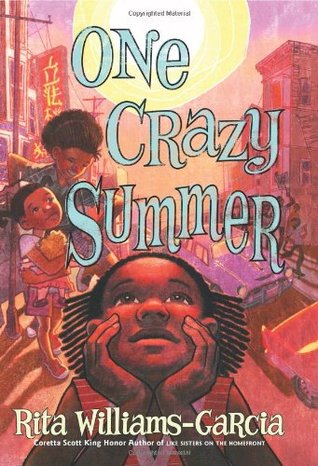
ONE CRAZY SUMMER by Rita Williams-Garcia

Set in Oakland, California, in the summer of 1968, three sisters are sent to spend four weeks with their mother that abandoned them years ago.  Eleven year old Delphine has had to grow up too quickly and become a mother figure to her two younger sisters: Vonetta and Fern.  When they arrive in California, they get a very cold greeting from their mother, Cecile, who makes it very clear that she didn't ask for them, nor did she want them there to visit.  Cecile is only concerned about her poems and sends the girls out of the house every morning. Through this month spent in California with their mother, they were hoping to visit Disneyland and meet Tinker-bell. Instead, the three sisters are sent to a nearby Black Panther summer camp, where they are fed a free breakfast and taught about family, freedom, and their country.

Cover Art by Sally Wern Comport 2010

Williams-Garcia, Rita. One Crazy Summer. New York: HarperCollins, 2010.  ISBN 978006070885


The main character in this book, Delphine, is a character that mid-elementary to junior high age children will easily relate to and empathize with.  She is forced to take care of her younger sisters when they visit their mother in California who is only concerned with her poems and printing.  The reader follows Delphine through this month with her estranged mother, and we get to see her find herself, make new friends, and even have a boy-crush.  The character of the mother is very hard to sympathize with, and she comes off as being very self-centered.  Toward the end of the book, the mother begins to explain to Delphine why she abandoned the girls, but the reader is left unsatisfied with no true reason why the mother left.  The Black Panther characters in the book seem very angry and violent, but a lot of their background is not touched on.  The reason for their protesting is never really explained.  

Even though the Black Panther group was not explained thoroughly, the tone of the time was kept true by the author.  The reader is able to see the racism and protests through the eyes of a young eleven year old girl, Delphine.  The author also stays true to the dress and speech of the 1960s, while using true to history characters such as Martin Luther King, Jr. and famous poets of the time.  

At the end of the book, the author acknowledges articles she read that helped her to relay the climate of the 1960s.  

Awards for One Crazy Summer


2011 Coretta Scott King Award Winner
2011 Newbery Honor Book
2011 Scott O’Dell Prize for Historical Fiction
2010 National Book Award Finalist
Junior Library Guild Selection
Texas Library Association Best Book for 2010

Reviews for One Crazy Summer

"Author Rita Williams-Garcia has a fine ear for the squabbles and fierce loyalties of siblings and a keen eye for kid-centered period details, including collect phone calls, go-go boots and the TV dolphin Flipper."  ~ Booklist

"Emotionally challenging and beautifully written, this book immerses readers in a time and place and raises difficult questions of cultural and ethnic identity and personal responsibility. With memorable characters (all three girls have engaging, strong voices) and a powerful story, this is a book well worth reading and rereading." ~ School Library Journal
"Set during a pivotal moment in African American history, this vibrant novel shows the subtle ways that political movements affect personal lives; but just as memorable is the finely drawn, universal story of children reclaiming a reluctant parent’s love. Grades 4-7." ~ Gillian Engbert, School Library Journal


Also by Rita Williams-Garcia 

Everytime a Rainbow Dies. Amistad, 2002.  ISBN 9780064473033   
Blue Tights. Puffin, 1996.  ISBN  9780140381453
Like Sisters on the Homefront.  Puffin, 1998.  ISBN 9780140385168
P.S. Be Eleven.  Amistad, 2013.  ISBN 9780061938627   (Sequel to One Crazy Summer)

Classroom Connections

Suggested age: Grades 4 - 8


Create a character web, or bubble map,  for Delphine.  Students can also compare themselves to Delphine.  

Students can defend or critique Cecile's role as "mommy, mom, or ma", defined by Delphine in the book.  

Who were the Black Panthers?  Students can discuss what they already know, then come up with questions they want to research and find out more about.  Then allow students to research this organization. 

Share poetry with your students by the poets that the author, Rita Williams-Garcia, gives acknowledgements to in the back of the book.  These poets include:  Nikki Giovanni, Gwendolyn Brooks, Lucille Clifton, Sonia Sanchez, and Kattie Miles Cumbo.