Set in Oakland, California, in the summer of 1968, three sisters are sent to spend four weeks with their mother that abandoned them years ago. Eleven year old Delphine has had to grow up too quickly and become a mother figure to her two younger sisters: Vonetta and Fern. When they arrive in California, they get a very cold greeting from their mother, Cecile, who makes it very clear that she didn't ask for them, nor did she want them there to visit. Cecile is only concerned about her poems and sends the girls out of the house every morning. Through this month spent in California with their mother, they were hoping to visit Disneyland and meet Tinker-bell. Instead, the three sisters are sent to a nearby Black Panther summer camp, where they are fed a free breakfast and taught about family, freedom, and their country.
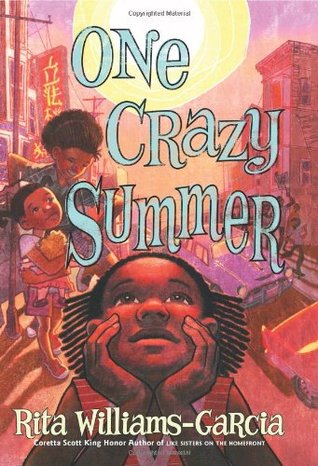 |
| Cover Art by Sally Wern Comport 2010 |
Williams-Garcia, Rita. One Crazy Summer. New York: HarperCollins, 2010. ISBN 978006070885
The main character in this book, Delphine, is a character that mid-elementary to junior high age children will easily relate to and empathize with. She is forced to take care of her younger sisters when they visit their mother in California who is only concerned with her poems and printing. The reader follows Delphine through this month with her estranged mother, and we get to see her find herself, make new friends, and even have a boy-crush. The character of the mother is very hard to sympathize with, and she comes off as being very self-centered. Toward the end of the book, the mother begins to explain to Delphine why she abandoned the girls, but the reader is left unsatisfied with no true reason why the mother left. The Black Panther characters in the book seem very angry and violent, but a lot of their background is not touched on. The reason for their protesting is never really explained.
Even though the Black Panther group was not explained thoroughly, the tone of the time was kept true by the author. The reader is able to see the racism and protests through the eyes of a young eleven year old girl, Delphine. The author also stays true to the dress and speech of the 1960s, while using true to history characters such as Martin Luther King, Jr. and famous poets of the time.
At the end of the book, the author acknowledges articles she read that helped her to relay the climate of the 1960s.
Awards for One Crazy Summer
2011
Coretta Scott King Award Winner
2011
Newbery Honor Book
2011
Scott O’Dell Prize for Historical Fiction
2010
National Book Award Finalist
Junior
Library Guild Selection
Texas
Library Association Best Book for 2010
Reviews for One Crazy Summer
"Author Rita Williams-Garcia has a fine ear for the squabbles and fierce loyalties of siblings and a keen eye for kid-centered period details, including collect phone calls, go-go boots and the TV dolphin Flipper." ~ Booklist
"Emotionally challenging and beautifully written, this book immerses readers in a time and place and raises difficult questions of cultural and ethnic identity and personal responsibility. With memorable characters (all three girls have engaging, strong voices) and a powerful story, this is a book well worth reading and rereading." ~ School Library Journal
"Set during a pivotal moment in African American history, this vibrant novel shows the subtle ways that political movements affect personal lives; but just as memorable is the finely drawn, universal story of children reclaiming a reluctant parent’s love. Grades 4-7." ~ Gillian Engbert, School Library Journal
Also by Rita Williams-Garcia
Everytime a Rainbow Dies. Amistad, 2002. ISBN 9780064473033
Blue Tights. Puffin, 1996. ISBN 9780140381453
Like Sisters on the Homefront. Puffin, 1998. ISBN 9780140385168
P.S. Be Eleven. Amistad, 2013. ISBN 9780061938627 (Sequel to One Crazy Summer)
Classroom Connections
Suggested age: Grades 4 - 8
Create a character web, or bubble map, for Delphine. Students can also compare themselves to Delphine.
Students can defend or critique Cecile's role as "mommy, mom, or ma", defined by Delphine in the book.
Who were the Black Panthers? Students can discuss what they already know, then come up with questions they want to research and find out more about. Then allow students to research this organization.
Share poetry with your students by the poets that the author, Rita Williams-Garcia, gives acknowledgements to in the back of the book. These poets include: Nikki Giovanni, Gwendolyn Brooks, Lucille Clifton, Sonia Sanchez, and Kattie Miles Cumbo.

No comments:
Post a Comment