Pages

background

Saturday, February 28, 2015

GUYKU: A YEAR OF HAIKU FOR BOYS by Bob Raczka

Poetic Form

Raczka, Bob. 2010. GUYKU: A YEAR OF HAIKU FOR BOYS. illustrated by Peter Reynolds. Boston: Houghton Mifflin Books or Children. ISBN 9780547240039.


A collection of haikus, this picture book tells a story of boys playing outside throughout each season. With puddles to splash in the spring, fishing in the summer, jumping in the leaves in the fall, and having a swordfight with icicles in the winter, this book of haikus captures the special moments that kids can have in the outdoors.  The reader is taken through all four seasons with playful ideas and ways guys play when given only the outdoors and their imagination. 

A haiku is a poem, usually about nature, that has a 5/7/5 syllable pattern. Each haiku in this collection by Bob Raczka follows this syllable pattern, but since they are about guys in nature, Raczka calls them Guykus. The title is very fitting, as we follow guys all through the book having fun outdoors and appreciating nature. The poems are screaming to be read aloud, while the reader is outside of course. Filled with personification, the reader can see and feel the happenings of nature in the haikus. 

Peter Reynolds, who is also known for The Dot, illustrated each haiku with watercolors. The illustrations are a phenomenal accompaniment to the haikus. My favorite illustration in the book is of a 'guy' laying on the ground with his dog, studying the sky. The illustrations are not too bold, so do not take away from the meaning of the poem. They add just enough to help interpret the haiku. 


The book features a writing at the end of the book, both by Bob Raczka and Peter Reynolds of the reasons they wrote and illustrated GUYKU. 

Spotlight Poem

Winter must be here.
Every time I open my
mouth, a cloud comes out. 


Classroom Activities

With all the snow we are getting, I had to choose this haiku from the book. I took my class outside to feel the snow yesterday, and we hadn't been outside a minute when three of my boys were making clouds come out of their mouth. This started a conversation about why clouds were coming out of our mouths.  This haiku would have been wonderful to have when we went back inside. 

To introduce each season of poems, take the students outside to read the poem aloud. Be sure to pause after each line to get the effect of the syllable pattern.  

After introducing a haiku from the book, or the book as a whole, you must introduce your students to the website, www.GuykuHaiku.com. The website highlights four poems, one from each season, and has an animated illustration from the book. There is also an abundance of ideas for teaching children to write their own haiku. Included are printables with illustrations or borders to help spark ideas for the haikus. Children can submit their haikus to Bob Raczka, for possible spotlight on the website. You must show them the haiku gallery, with haikus written by children. 

Monday, February 23, 2015

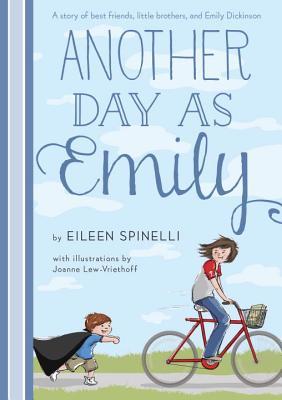
ANOTHER DAY AS EMILY by Eileen Spinelli

New Poetry for Children and Young Adults


Spinelli, Eileen. 2014. ANOTHER DAY AS EMILY. illustrations by Joanne Lew-Vriethoff. New York: Alfred A. Knopf. ISBN 9780449809877.

Another Day as Emily is a novel in verse by Eileen Spinelli for upper elementary and middle school grades. Eleven year old, Suzy, is the main character in this wonderful story. Her brother calls 911, when an elderly neighbor has "a spell". He becomes the local hero and Suzy finds herself jealous of the attention he is getting, especially when he ruins her birthday plans. Her best friend, Alison, is very different from Suzy, but they find themselves to be kindred spirits. Alison talks Suzy into trying out for a play, but when Alison gets a part and Suzy doesn't, Suzy finds herself more disappointed than she ever imagined. Suzy feels as if she is cast aside from many directions, and she finds solace in reading Emily Dickinson poems, and decides to live the same life that Emily lived. Suzy finds that being a recluse is more difficult than she thought. Will Suzy be able to continue this life with no friends and no outings?

Critical Analysis

Another Day as Emily is a new book, published in May of 2014, written in free verse. The short poems will be appealing to young readers, especially reluctant readers. Children, especially girls ages 8 to 12, will relate to the main character. Suzy faces many challenges that children face, such as jealousy of a younger sibling, a first crush, and fighting with your best friend. Emotions are high throughout the book, just like young girls' emotions. 

Many of the poems in the book are fabulous, filled with sensory images. When Suzy goes outside, the poems are beautifully written and create a world for the reader where we can even feel the wind that Suzy feels. For the most part, the poems have a rhythm, and pause at the end of the line in a natural way. The end of the lines have an effect on the reader to pause and take in the meaning and imagery of the words. However, there are a few poems/chapters in the book that are written choppy. Eileen Spinelli does a fabulous job of writing as a child and allowing the reader to see the mind of Suzy, the eleven year old. 

Spotlight Poem

Into the Breeze

It's a bright afternoon.
I ride my bike
into the warm breeze,
away from the house,
along the bike path.
Trees ripple green.
The light is golden.
The sky is blue.
And I am a bird
flying.....
flying.....
Alison doesn't know
what she's missing.

~Eileen Spinnelli


While reading this poem aloud, I would have children close their eyes and pretend they were on a bicycle. If it is a warm, sunny, day, I would take them outside to read the poem.

Classroom Connections

Reading Emily Dickinson poems would be a great connection to go with this book, especially "I'm Nobody, Who Are You?", which is mentioned several times in this book. 

There is a poem in the book titled, "Mrs. Harden's Treasure Box". After reading, have students draw items they would have if they had a treasure box. 

Another Day as Emily could accompany a history lesson, where students could research the dress and transportation back in the 1800s. There are numerous references to people and the dress during the time that Emily Dickinson was alive. There is a poem, "OH", where Suzy's dad gives her a history lesson on the bicycle and how only men could ride bicycles. This would be a great discussion starter for your classroom. 

Other Novels in Verse by Eileen Spinelli

WHERE I LIVE. 2007. Dial Books ISBN 9780803731226.
THE DANCING PANCAKE. 2010. Knopf Books for Young Readers. ISBN 9780375858703.
SUMMERHOUSE TIME. 2007. Knopf Books for Young Readers. ISBN 9780375840616. 


Saturday, February 14, 2015

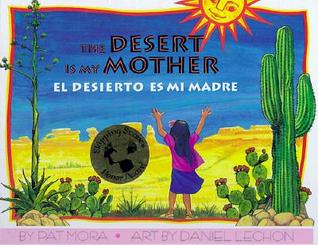
THE DESERT IS MY MOTHER by Pat Mora

Multicultural Poetry


Mora, Pat. 1994. THE DESERT IS MY MOTHER - EL DESIERTO ES MI MADRE. art by Daniel Lechon. Houston, TX: Piñata Books. ISBN 9781558851214.

A Skipping Stones Honor Award Book


Pat Mora is an award winning Latino poet and author. In this picture book, The Desert is My Mother, Pat Mora pairs up with the painter, Daniel Lechon, to create a story of Mother Nature. A young, dark haired girl narrates the poem describing the beauty of the desert and all it provides for her. Throughout the poem, the young girl invokes the powers of the desert, and the desert responds. The desert provides for her everything she needs, such as sun, water, life, and healing powers. The poem is written in English, translated in Spanish. As you turn the pages, a new stanza of the poem appears, with English on the top and the Spanish translation below.

The poem, by Pat Mora, is free verse, however follows a specific pattern throughout.  Each stanza begins with a short line, followed by a longer line. There is a definite rhythm found while reading the poem, making for a great read aloud for students working on fluency. Mora uses an abundance of metaphors and personification throughout this poem, creating a vivid image of the desert for the readers. Just like Mora's other award winning poems and books, this poem is brilliantly written.

The art in the book is created by Daniel Lechon, a prize-winning artist. Lechon adds to the imagery of the poem, illustrating the beauty of the desert, as well as the dreamy girl narrating the story. Lechon's illustrations show the expressions of the girl change through the story as the desert changes. When the desert provides her with rain, we see her joyful expression in the illustrations. When the desert yells out with thunder, the illustrations show her fear. The pictures of the girl are framed by a sand texture, adding to the imagery of the desert.

Spotlight Poem


I say frighten me.
She shouts thunder, flashes lightning.

I say hold me.
She whispers, "Lie in my arms."

I say heal me.
She gives me chamomile, oregano, peppermint.

I say caress me.
She strokes my skin with her warm breath.

excerpt from THE DESERT IS MY MOTHER.

Classroom Connections


Many grade levels have habitats and environments included in their Science TEKS, and this book would be an excellent addition to this unit. After reading the poem, the students could choose a different environment to write a poem about. 

While reading the poem and introducing, play background music with desert sounds.  Then, replay the music while students write about what they hear. Then have them share in groups their thoughts and writings.

Since there are two lines in each stanza, you could have pairs, or groups, take turns reading the lines of the poem.

Pat Mora includes many actions in this poem, with many opportunities to teach personification. You could have students act out this poem while reading it. 


Friday, February 13, 2015

MIRROR MIRROR by Marilyn Singer

Singer, Marilyn. 2010. MIRROR MIRROR: A BOOK OF
REVERSIBLE VERSE. illustrated by Josée Masse.
New York: Dutton Children's Books. ISBN 9780525479017
NCTE Award winning poet, Marilyn Singer


Marilyn Singer combines poetry with fairy tales in this amazing book of reversible poems. It is the first I have seen of this type of poetry. Classic, popular fairy tales are included, such as Snow White, Rapunzel, Cinderella, and Sleeping Beauty. Each poem shows two sides of the story, from the princess' points of view and even sometimes the wicked stepmother's point of view. 

This book is ingenious! I read it to my nine year old daughter, and her jaw dropped after the first poem.  It is amazing that the poems are read from top to bottom, then the reader can flip the poem, reading it up the page. The poems are reverse images of themselves, and tell a story in both directions. The most amazing thing about the poems is that even though they are mirror images of themselves, the reverso poem tells the story from a different point of view. 

Throughout the picture book, there are 14 reverso poems. The reverse, or mirror image, of the poems are written in a different font and color, which helps distinguish the poems. The reverse of the poems allow for punctuation, capitalization, and line break changes. A few of the poems are written in rhyme, but most are free verse. There are two poems that were hard to find a rhythm while reading, but overall, the poems are full of rhythm.

The illustrations, by Josée Masse, are absolutely fabulous. The colors used are vibrant and fun. The illustrations, just like the poems, are drawn in a split image, showing the two characters that are narrating the poems. 

Spotlight Poem

Bears in the News

ASLEEP IN CUB'S BED,
BLONDE
STARTLED BY
BEARS,
the headline read.
Next day
Goldilocks claimed,
"They shouldn't have left
the door
unlocked."
She
ate the porridge.
She
broke
a chair.
"Big deal?
No!
They weren't there."

They weren't there.
No
big deal?!
A chair
broke.
She
ate the porridge.
She 
unlocked 
the door.
"They shouldn't have left,"
Goldilocks claimed.
Next day
the headline read:
BEARS STARTLED
BY BLONDE
ASLEEP IN CUB'S BED.

excerpt from MIRROR MIRROR.


Classroom Connections


This book of reverso poems would be an incredible addition to any fairy tale unit, especially if you are reading fractured fairy tales and comparing them.

After introducing the above poem, Bears in the News, have students look at editorial pieces in newspapers that are written from different perspectives. Then have the students get into groups and decide if they will write from Goldilocks's or the Bears' point of view, and have them write an editorial for the newspaper.

Later, you could have them do the same for other fairy tales, such as The Three Little Pigs, writing from the pigs' or the wolf's perspective. You could incorporate technology, and teach the students to type in a two column format. 

Challenge your students, and yourself, to write a reverso poem!

A Fun Fact

Marilyn Singer wrote a poem about her cat that could be read up and down. She did this just for fun. She had such a good time composing it, that she challenged herself to write more reverso poems. 


Thursday, February 5, 2015

DINOTHESAURUS by Douglas Florian


Florian Poetry


Florian, Douglas. 2009. DINOTHESAURUS. New York, NY: Atheneum Books. ISBN
9781416979784


DINOTHESAURUS is a compilation of poems by Douglas Florian with fun facts about 18 different dinosaurs. Beginning with the Brachiosaurus, you will find humorous, witty poems including the popular T-Rex, Iguanodon, and Triceratops. This anthology is a must for any dinosaur fan. Each poem provides facts about the dinosaur in a fun, rhyming manner. Douglas Florian brings the dinosaurs to life with words and art.

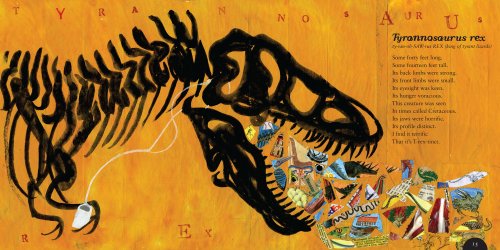
Florian is the illustrator in this compilation, as well as the poet. The illustrations are collages completed onto brown paper bags. They consist of colored pencils, water colors, collage, stencils, and stamps. The illustration accompanying the poem, Tyronnosaurus rex, is very vivid. Florian uses newspaper and magazine cuttings to create a collage depicting items the T-Rex possibly had eaten. The collage type illustrations are soft and fun, different from the bold, sometimes scary, illustrations of dinosaurs often found in books.


Each poem provides the pronunciation of the dinosaur names, as well as the meaning of the name. There is a table of contents at the front of the book to help find each poem, and a 'Glossarysaurus' at the back of the book. This provides more information and facts on each dinosaur.  There is even a drawing of Mr. Florian as a dinosaur himself. 

The following is an excerpt from DINOTHESAURUS that depicts Florian's use of rhyme, rhythm, and humor. 

Barosaurus

I'm higher than five elephants.
I'm longer than most whales.
My giant neck is balanced by
My forty-three-foot tail.
A tail that is my weapon.
It swings from side to side.
From nose to tail I'm ninety feet --
Hey kid, ya wanna ride?

Classroom Connections

This book would be an excellent addition to any school library for classroom use during a dinosaur or poetry unit. The teacher can start out with a KWL chart showing what the students already know about dinosaurs. 

After reading, each student can choose a poem to act out. Douglas Florian uses lots of action in his poems throughout this book, so it would be fun for students to act out their dinosaur. 

The class could discuss the illustrations and how each shows details provided in the poem. Some of the details will be hard to find, so this can be a fun hunt and find activity for your class. Consider placing the illustrations on the projector so that the whole class can see.